
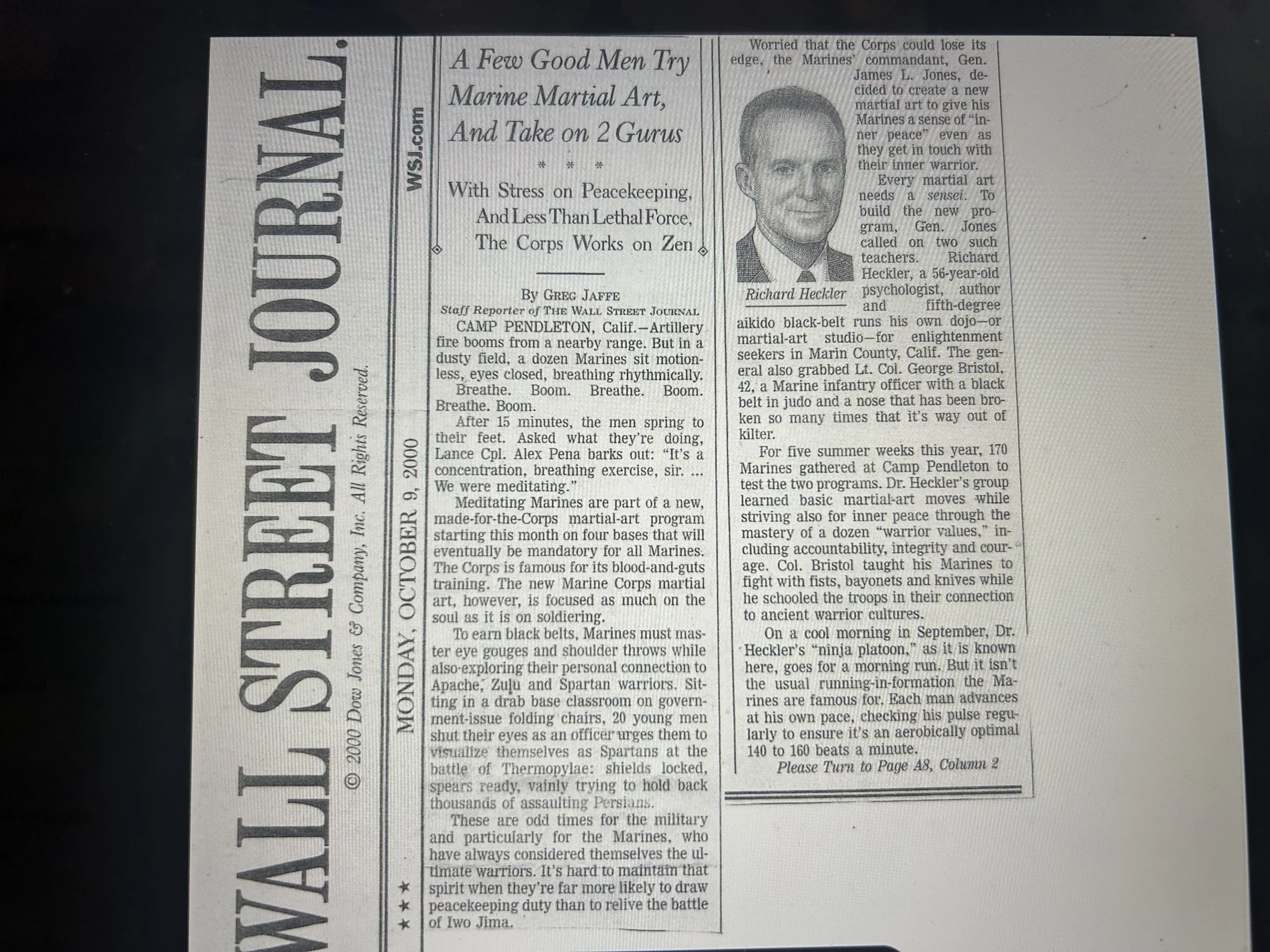
An article from the Wall Street Journal below showcases Richard Sensei’s groundbreaking work in 2000 with the Marine Corps Martial Arts Program.
The Practice of Seeing and Being Seen: Part 5
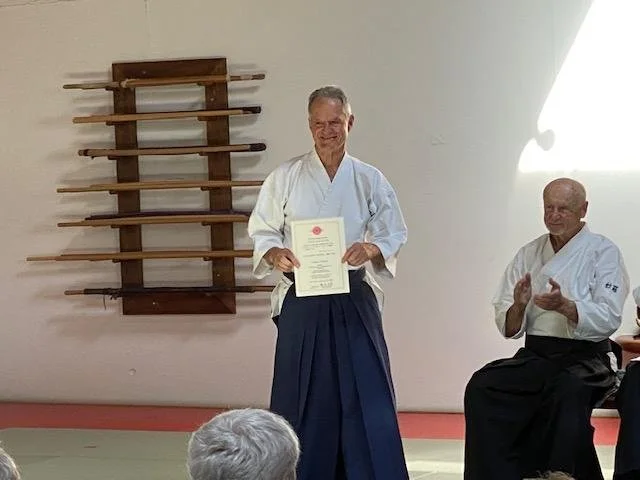
Deflecting Love
In Part Four of this series we briefly touched on how a contraction can overtake us when we’re positively acknowledged; this contraction shows up as a deflecting of not only what is being said, but more importantly, dismissing the speaker as well. This, of course, can have disastrous results for the relationship. We trap our breath, squeeze the diaphragm, avoid eye contact, armor ourselves from receiving an intimate acknowledgement. Of course this can happen with a negative response as well, but for now it’s worth pausing to look at what is it about us that deflects the intimacy of being positively recognized. What’s the cost of this separation, and how can this divide be mended? This is important because being seen and seeing are built on a mutually inclusive relationship; they’re two players of the whole. This mutuality convenes intimacy, authenticity, love, and deeper connection with self, others, and the world. By becoming aware of the historical conditioning that has us avoid this level of intimacy it’s possible to make different choices that are more life affirming; more aligned to our basic needs of safety, belonging, and dignity. This opens up the possibility to fully receive love, and to fully give love. This is a fundamental step in recognizing the truth of our interdependence and interconnectedness.
The example I used of myself in part four was an inherited etiquette I learned as an athlete of how one should respond when applauded for an outstanding performance; as well as what I learned in the traditional Japanese martial arts, that is, bowing and stepping away with a dignified self-effacing. When this becomes embodied as a contextual norm it serves the purpose of belonging. In this case belonging to the community of athletes, or martial artists in which this behavior is affirmed. However, as I mentioned in my example, it was a false modesty, a way of appearing unaffected by the recognition of others, a way to seem above the normal conventions of “needing” approval. This inhibits the possibility of an authentic meeting that is spiritual in nature.
What I have repeatedly seen is that a deep seated feeling of being deficient, of being flawed, of unworthiness is at the core of deflecting being acknowledged in a positive light. The story of a man I’ll call Carlos exemplifies this theme.
Carlos was raised by a single, alcoholic mother who was unable to take care of him. She was kind and loving but dysfunctional. She would consistently fall into stupors and black outs, her neglect increasing until Carlos was finally put into the foster care system. The central messages he received as he rotated through different foster families was that he was fundamentally flawed, undeserving of anything other than sharing a bed with three other boys and having one set of clothes. Despite this he did well in school, played varsity sports, and had a steady girlfriend. Yet he deflected any affirmative acknowledgement of his accomplishments; he would either deride the speaker, break contact by walking away, or simply shaking his head. When he was in high school he began to live with his mother again who had been sober for three years and held a steady job. As he began to look past high school the only thing that he thought he was suited for was being a janitor. He would watch the janitors at his school and thought this was something he could do with the chorus in his head confirming “You’re not worthy or deserving of anything else.” While his mother offered nothing other than this future his girlfriend encouraged him to apply to college which he did and was accepted with a partial scholarship. When the acceptance letter arrived he wouldn’t open it, so his girlfriend finally opened it. When he found out that he was accepted he thought it must be a mistake, a trick that the school was playing on him. In actuality he was quite bright in mathematics and science, but he was severely hampered by the narrative of unworthiness to the point of being paralyzed. He was unable to take any initiative in improving his situation. The refrain “You’re not worthy” was a loop that played over and over in his mind.
When people gave him favorable responses, or encouraged him to reach outside his limiting beliefs he would immediately mistrust them. He thought they were lying so they could watch him fail. His girlfriend helped him through the administrative details of enrolling and accepting the scholarship, and encouraged him to attend classes. He spent most of the time in his dorm room and at the end of the year he was asked not to return because of failing grades. “All I thought was that I wasn’t deserving. I just wasn’t worthy of going to college, or having a good job, but I thought I could be a janitor” he would say. The closest thing to praise that he received was when a foster parent would say. ”At least you didn’t make a mess of things.”
I met Carlos when he came to the aikido dojo. He immediately took to the training and the philosophy. Although he kept to himself and didn’t mingle easily with the other students he trained regularly and sincerely. At that time he was living his story working part time for a cleaning company. Training for his black belt test he began to build trust with me and one evening after class he told me his story about being raised in foster homes, his mother’s addictions, and his failing out of school. Through his aikido practice he began to see he was improving and it increased his self-confidence; yet he would still disrtrust any positive affirmation about his progress. At one point when I mentioned that his technique was improving during a particular demanding multiple person attack he flinched as if avoiding something coming towards him. It was subtle but it was clear that it was his conditioned reaction about any assessments that challenged his story of being unworthy. Inexplicably it occurred to me that in the previous practice he didn’t flinch or draw away when a lightning bolt of a fist was aimed at his face, or when there were committed lunges at his throat. From a centered posture he would re-direct the attacker’s energy without folding in on himself and neutralize the attack. It was then that I knew that he didn’t recognize that shame wasn’t necessarily a solid fixture in his inner landscape. Could he understand that not flinching from a strike to the nose, which he handled with dignity and self-possession, was a reflection of an inner strength he had been cultivating in his aikido practice: a state of being that would allow him to become more confident about his potential.
As part of his run-up for his black belt test I suggested he take 30 minutes a day and repeat “I’m worthy” while being solidly in his body, so it wasn’t simply an idea he was repeating, but a feeling sense that became part of him. Because of his aikido practice he knew how to make this declaration from a somatic ground. This made all the difference between simply reciting words, to an embodiment practice that could re-wire his nervous system; that in turn would re-orient him from a limited world view of insufficiency to a fulfilling future of dignity, safety, and connection. This sounds simple and it is, but not simple in an unsophisticated, naïve way, but in an uncomplicated direct manner that allows our intent and our actions to become one.
I recommended a somatic practitioner that Carlos could work with that would assist him in releasing the muscular contractions that kept him from opening to new possibilities, which in turn would aid him in his black belt test. Carlos had an exemplary test and when it came time for spectators and his fellow aikido students to applaud he stood proud and open to receiving their hearty acknowledgement. Watching him in full dignity of his accomplishment I knew he had crossed over a huge inner barrier that had long been his nemesis. He was letting their love in, and by his receptiveness he was returning love. Carlos eventually earned a technical degree in computer science, and was hired by a technology start-up. He moved out of the area but found a dojo he could continue his training. It didn’t escape me that when I saw Carlos embodying his new found self-respect in front of his peers it was the exact opposite of how I responded those many decades ago when I was seen and applauded.
Take it Easy, But Take It,
Richard Strozzi-Heckler
The Practice of Seeing and Being Seen: Part 4
A Covenant of Mutuality and Interdependence
To be open to being seen is a skill as well as an art; just as a deep seeing is a skill and an art. When we allow ourselves to fully receive someone’s generous, cultivated attention we participate in a covenant of interdependence and mutuality. The sincere participation of both parties introduces the felt reality of our oneness, the unity of our ground of being: this is a fundamental spiritual principle. When we allow ourselves to be open in this way the boundaries between ourselves and others, between ourselves and nature, between ourselves and life itself begins to evaporate. A tutorial in being seen and received was introduced to me after I had finished presenting at a large seminar.
As I completed and began to walk away the attendees gave me a boisterous ovation and I automatically responded with the customary Japanese bow that is deeply part of me from my years in Aikido. I suddenly saw that I was unconsciously performing something that was completely divorced from the acknowledgement that was being offered. I was simply not letting in their jubilant response; instead I created a barrier that shielded me from the intimacy of the present moment. I was hiding behind custom to conceal a feeling of vulnerability. I felt exposed. My conditioned historical response streamed through me to protect, to shelter, to defend me from…it’s difficult to say what it was protecting me from as there was no pertinent threat, but the rush of heat that surged up my spine made me feel as if I was standing dangerously close to a precipice. Some unexamined threat lurked in the shadows of memory.
What I had inherited from the etiquette of Aikido, and the wider culture, was that you simply bow and walk away. Much like the athlete who takes a nod after a game winning basket, goal, or homerun and then disappears into the runway, which is seen as a virtue of modesty and self-possession. In this case it was a false modesty and inauthentic; I was just going through the motions without regards to what was actually occurring. I simply disappeared the audience and their generous acknowledgement. I saw that not acknowledging others is an act of radical dismissal; it’s a way of disappearing them. They were the Other. Seeing this I felt jarred, unmoored, my mouth coated with chalk.
Inexplicably in that instant I was reminded to wake up, return to the present moment, and respond with dignity. I paused, stood straight, took a breath, uncurled my shoulders, looked directly at the participants, and let their appreciation touch me, and then I bowed. In that bare slice of time it felt as if the air between us had been scoured, the light seemed gilded with a substance-not salt, not cloud, not rock, not a word that comes easily-that was like a bright wick of fire emanating from all souls present. There is both a fragility and a solid ground in our vulnerability that allows us to share in that which we can feel and sense, but not necessarily locate in language. This teeter totter between the Absolute and the Relative leaves me witless. This wonderous bewilderment makes me wonder if this is the beginning of wisdom. I heed Dionysius advice to his disciples “Abandon everything, God despises ideas.” The sacred is everywhere, however fleeting; most of all waiting in the shadows. As I returned from this bright moment I longed for a balm that would integrate this potent energy; perhaps the sun light, I thought, latticing the floor through the windows.
Yet what surprised me, what was most impactful, was that being present to their acknowledgement, being present to them seeing me, enriched and dignified them. When this happened they applauded even louder. It was as if openly letting in their thanks empowered them, which empowered me. Opening to being seen and acknowledged merged with their experience of seeing and acknowledging. The innate unity between self and others has a collective power that is much greater than individual feelings and preferences.
The insight of this moment spontaneously combusted into an awareness of how I had constructed a certain teflon quality that prohibited positive acknowledgements, even love, to touch me at a deep level, though I longed for it. This led me to begin a practice of explicitly saying “I’m letting in your love, or appreciation, or good words” to the person who acknowledged me. If it seemed inappropriate to say it out loud I would say to myself, “I’m letting in your love.” Every time I did this I would feel my feet on the ground, my breath expanding my ribs, my shoulders settling into their pockets to help me embody the intimacy and truth of the moment.
To be seen means someone sees your concerns, motives, intent, historical urges, habituated responses, longing, and Being-ness. This practice of receiving, or seeing and listening deeply to someone is what we train in Aikido, and in somatics.This is what we call musubi, which in Japanese means knot.In other words we practice tying into our partner’senergy to be curious about them, listen to them, and then interact with them in a manner in which there is the possibility of a radical preemptive mutuality. This doesn’t necessarily mean agreeing with them, merging with them, judging them, or classifying them but fundamentally listening to the deepest part of them; being with their essence, being with their soul. Seeing their deepest conditioning as well as their deepest longings, joining with their sacred fire
Take it Easy, But Take It,
Richard Strozzi-Heckler
The Practice of Seeing and Being Seen: Part 3
The Sea Shell and the Sea Horse: The Intimate Healing of Being Seen
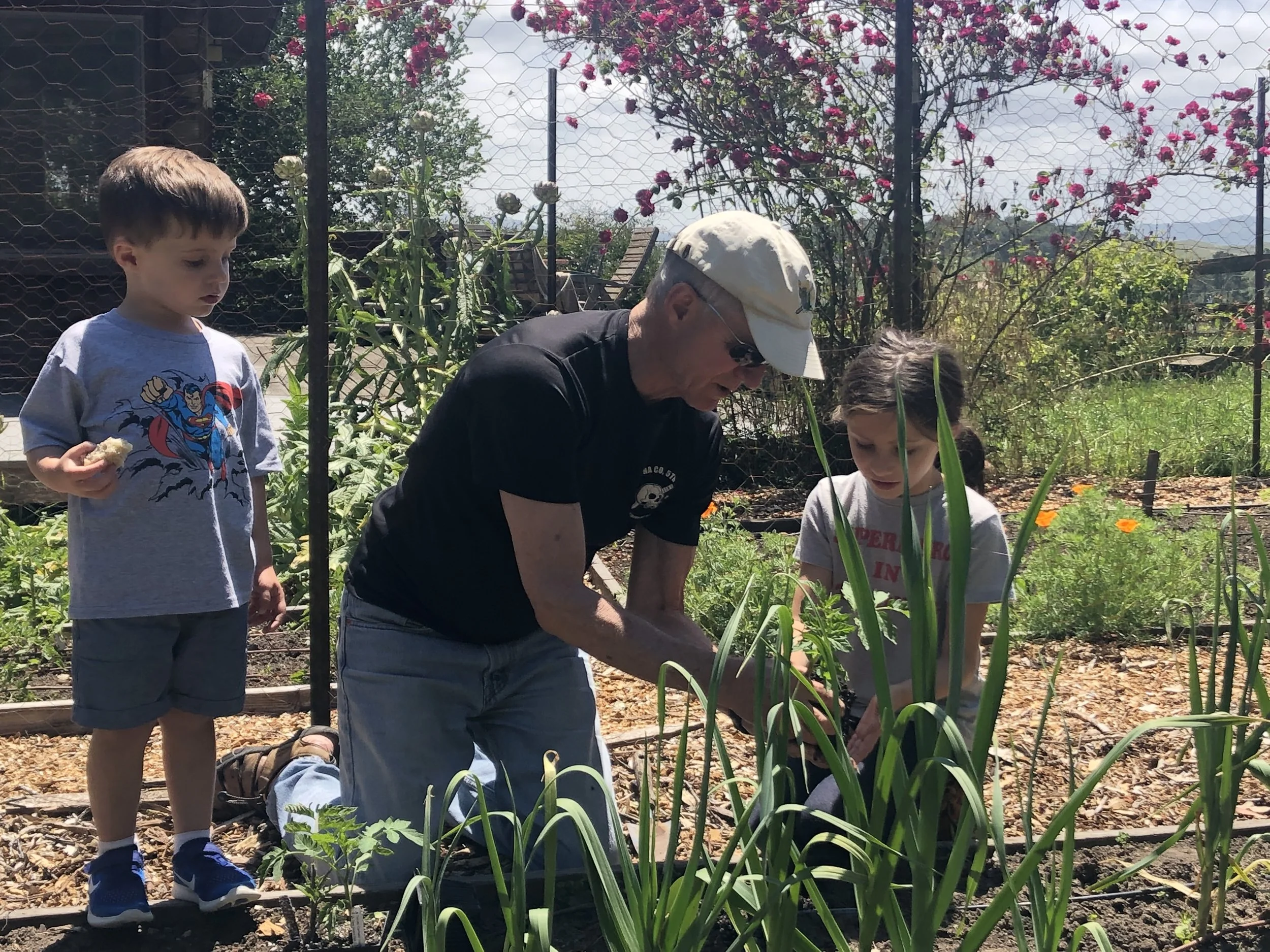
The healing power of softening the boundary between ourselves and others by being deeply seen and deeply received was recently revealed to me in a context other than managing a physical threat. Cameron, my seven year old granddaughter, returned home from her first day of school with a story she illustrated, wrote, and stapled together in book form about a seashell falling in love with a sea horse. When I asked her if I could read it she demurred by offering to read it to me. She then took the position that was most likely how her teacher read to the class: the booklet pointed towards me, her turning the pages, reading the story out loud, and pointing to the drawings that illustrated this unlikely, but tender relationship. I was delighted and impressed by her writing and drawing. I told her we could now share stories we wrote, pick out books at the bookstore, and read together.
Then I asked her to give me her attention, and when our eyes locked I held her story up between us and said, “But more than anything Cameron, I want you to know that this tells me who you are.” She looked at me intently for a long moment then with a deep sigh she softened, letting go into me, resting her head on my shoulder. “Thank you” she said. In that moment Cameron felt seen, not for what she had done, but for who she is. It was an extraordinary moment in which I once again saw the power of seeing and acknowledging someone at their core. While she was moved I felt equal to the benefit, and grace, of seeing her soul, if you will.
A year later Cameron and I exchanged roles. I was at my son Django’s house telling him about a recent incident that had me recall the acrimony that existed between me and my father. My father was emotionally and physically abusive and there was an on-going tension between us as I was growing up. This led him to formally disowning me, forbidding me from ever returning to the house, or even having my name spoken in his presence. This was something that Django and my other children knew, and we had discussed it a number of times. They knew the pain and struggle this rejection had created for me and how it was a central issue in therapy. Now I was simply reporting a new insight but without any affect.
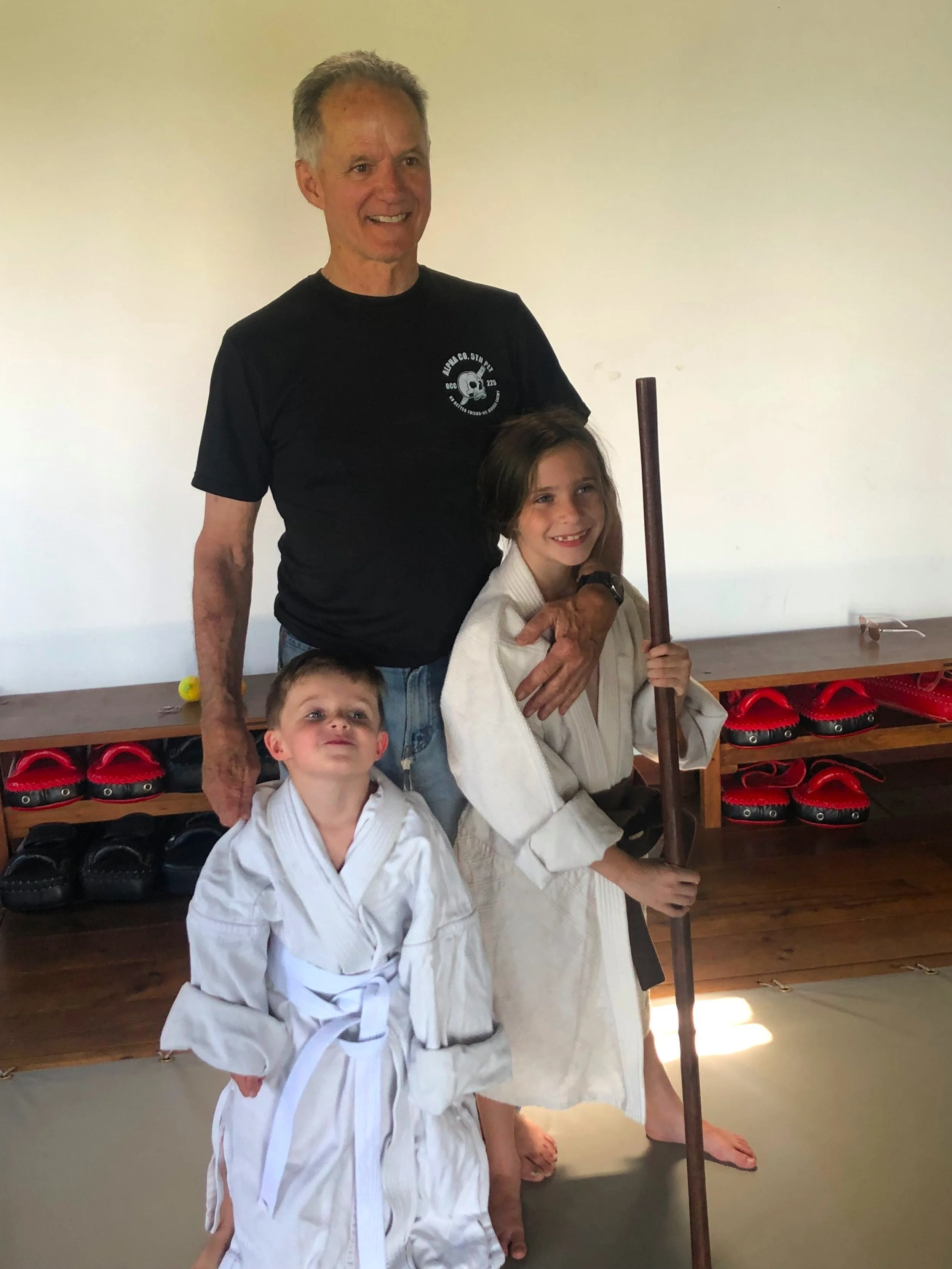
As I continued I noticed that Cameron and her brother Logan, who was five at the time, slowly turned from what they were doing and began to focus on me. I continued with no emotional charge when Logan, wide-eyed and incredulous, interrupted me. “You mean he kicked you out of your house!?” When I nodded affirmatively Cameron purposefully and slowly walked over to me, her eyes shining with compassion, put her arms around me, gently patting my back and said, “I am so sorry. I am so sorry.” Tears spontaneously rolled out of my eyes, and an upwelling of love and belonging enveloped me, soaking my soul in an ocean of tender care. This was a rare moment in which I felt deeply seen, and I allowed her heartfelt compassion to touch me. Despite the many hours of therapy I’ve spent on this issue of being rejected by my father her open-hearted kindness opened new doors of emotional healing. Cameron seeing my deepest wound, fully grasping a foundational experience in my life, was a sacred moment of repair and mending. That moment has become a cornerstone that I call on when I need to resource myself.
When we’re seen and acknowledged, when we’re held with dignity, respect and kindness, a molecular cascade of the “feel good” hormones floods our brain. To be seen clearly in a heartfelt manner generates a feeling of well-being that contributes mightily to our emotional and physical health. It’s like when the first light of the early morning sun touches our face, filling us with hope, joy and the beauty of life. While we’ve known this for millenniums, the technology of neuroscience scientifically grounds this experience for our empirical suspicions. This feeling is particularly compelling when our vulnerability and helplessness are treated with dignity, as well as when our aggression or defensiveness are received with generosity and warmth.
And there was something else.
My response to Cameron’s compassionate seeing showed me that there was still unfinished business with my father to integrate. Her deep seeing revealed that my dispassionate tone, without feeling, kept me at a safe distance from the deeper impact of the father rejection. She saw through this and let her heart speak. Her recognition and caring embrace moved me towards a deeper level of inquiry into how I’m still being run by this event sixty years later.
Powerful and sobering.
And there was more.
Logan then ran over to his father, grabbing his arm in celebration shouting, “My Dad would never do that!”. After a moment’s pause he looked up at him and in total seriousness asked, “Would you?” We laughed and then Django affirmed he would never ever leave them and sealed it with a hug, their arms wrapped around each other. This was a moment of collective healing. Cameron and Logan felt confirmed that their father would never abandon them; Django saw again that I had broken the karmic chain of the father son wound which he didn’t inherit, nor duplicate; and the next level of my shame had been uncovered, which gave me the strength to face deeper into the healing process.
The first example of Marcus revealed how deeply seeing someone has the potential of dissolving aggression and violence.
The second example with Cameron shows how being seen can generate intimacy, and emotional healing.
The third example of Django, Logan, Cameron and myself is an example of a collective healing when a deep seeing occurs. In our case it also revealed that I had broken that pattern of abuse from my father, and it wasn’t passed on to Django, and he hadn’t passed it on to his children.
Whenever I recall the energy of that unconditional hug and love from Cameron I return to a positive, affirmative view of life. In all of my virtues, scars, and blunders I had the experience of being fully seen and received by her; and I was able to receive her love. Two sides of the same energy. At the deepest level there is a unity between the giver and the receiver, the positive and the receptive, the seer and the seen. A foundation for an authentic connection is to fully see the other, and for the other to be open to being seen. To do this minimal trust must be granted; at the same time trust can grow in this rich relational field. When we see with a sincere heart we are rewarded with the intimacy and satisfaction of contributing to the other. And when we receive that gift with an open heart we dignify the seer, and we grow closer to the human being we want to be.
Take It Easy But Take It,
Richard Strozzi-Heckler
The Practice of Seeing and Being Seen: Part 2
An Aiki Thing To Do
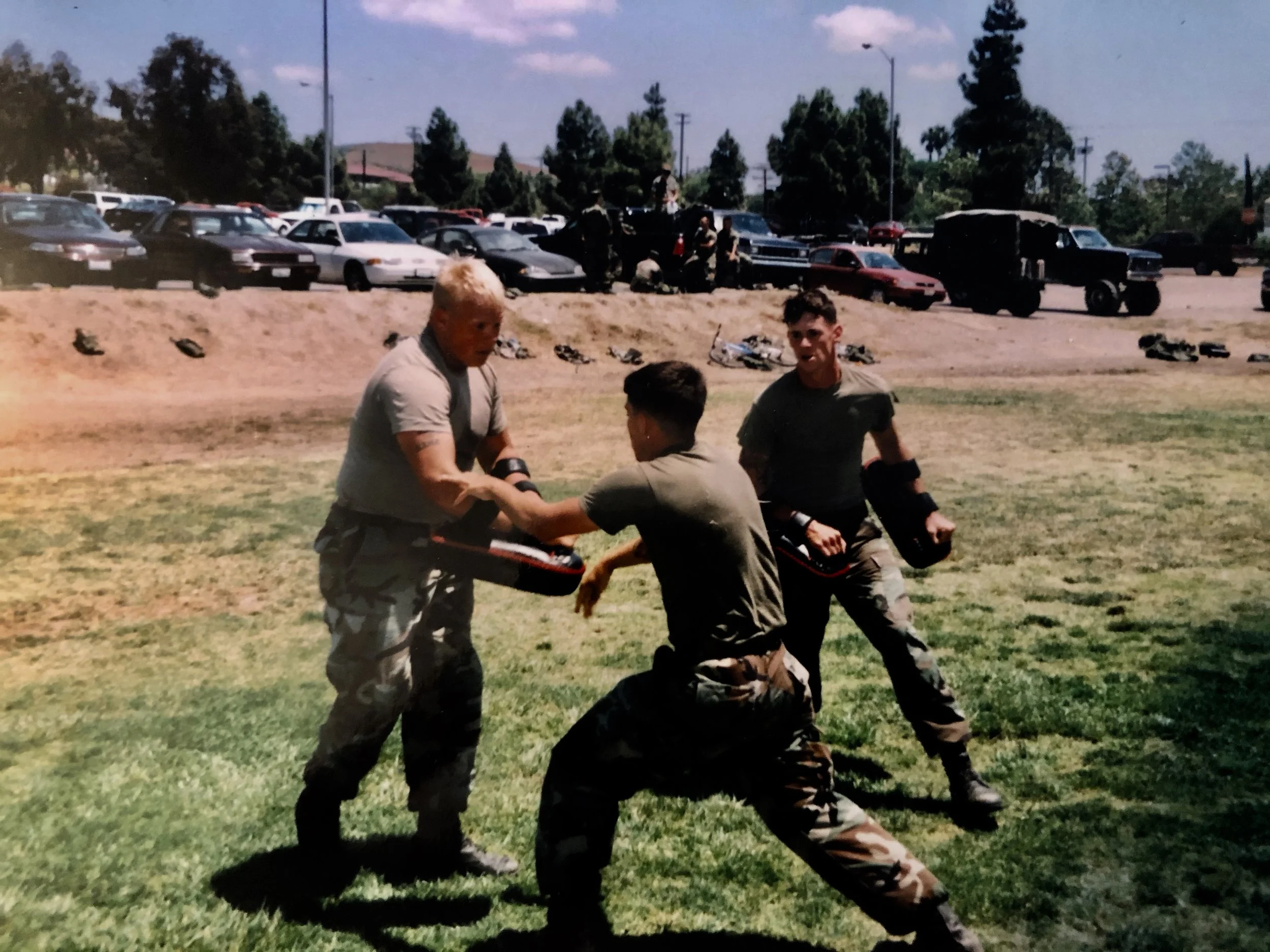
I first met Birks when he was recently promoted to First Lieutenant, just over a year out of The Basic School. He was the officer that supported our efforts running the Marine Corp Martial Art Program (MCMAP) at Camp Pendleton, California in 2000. In his support position he was close to the project yet wasn’t a direct participant, but he was intensely interested and hounded me daily about what we we’re doing. “Show me the techniques you taught today; how would you use it in combat; have you ever had to use it; explain the importance of irimi” he would ask. I would take some time at the end of the day answering his questions and going over various techniques with him. He was authentically fascinated by what we were doing, and at the same time his inquiries were always guided by the pragmatic view of, “would it work?”.
He was a champion Division 1 Collegiate wrestler in college and had tried a number of martial arts. He was tough, disciplined, and carried a big heart in his barrel chest. I would show him what we were doing and he would hang around as much as his time allowed. He was equally interested in the philosophy of Aikido and the methodology we used teaching the teachers as much as the techniques. He was a solid Marine who cared about his men and he thought what we were doing would help his Marines, and make him a better leader. At some point I gave him the names of some Aikido dojos in the area and he began training.
Over time I would get emails from then Captain Birks who said he was continuing his Aikido training whenever he could. Then I heard a story about a Marine officer near Falluja, Iraq who had his patrol drop to one knee, take their helmets off, and bow their heads as an Iraqi funeral procession passed by. This diffused a potentially dangerous moment as the funeral crowd was outraged seeing an American military unit patrolling their neighborhood, and they made threatening gestures in response. Later the Iraqis spoke the officer’s virtues in how he respected their culture and community. Coincidence or not, Captain Birks’ unit suffered minimal casualties and attacks in their area of operation after this incident. Later when I asked Birks if this was him and why he did it he said, “Yes it was me and it seemed like the Aiki thing to do.”
When I asked him what he meant he was silent for a while and then replied, “Actually in the moment I wasn’t thinking anything really. We had been in some tough fights where I had lost some men and I was very vigilant. All of us were. Then I saw that these Iraqis were also on guard and wary of us, actually devastated by what was happening and they were grieving loss just like I was and for no reason I can explain I told the men to take a knee and remove their helmets. I knew what it was like to lose someone and…” Here he became quiet again gathering himself and then after a bit said, “I think what happened was that I remembered blending, about seeing where they were coming from, seeing where the energy was going and going with it. You know Aikido. It was the Aiki thing to do.”
Take It Easy But Take It,
Richard Strozzi-Heckler
The Practice of Seeing And Being Seen - Part 1
The Perfect Technique: The Presence of Understanding
Some years back I was asked as a somatic therapist to consult at a residential treatment center with a population that had a variety of psychological diagnoses. One man was a borderline schizophrenic and having worked with him on previous visits I knew that he could abruptly cross that line into anger and paranoia. Earlier in the day he became upset with me, saying I wasn’t helping him like I should. He then turned away visibly upset, his hands knotted in fists. That evening I was in a de-briefing session with the staff when this man, who I’ll call Marcus, came to the door. The woman who answered the door was startled, not only because he showed up, but because of his disheveled appearance, and distressed expression.
He told her that he had come to borrow a book that was recommended to him by one of the staff. Leaving him at the door she hurried off to find the book. When she left he stepped inside the room, looked in my direction and immediately headed towards me. I was instantly on alert, sensing (or imagining) that the bulge under his jacket was a weapon; a gun, I thought. My stomach churned. Everyone around the table froze. He stood over me and began an accusatory tirade that ended with, “and I have a knife”. He then zipped open his jacket gripping something inside. His eyes were feral, his breath labored, his face blotched as if a fire was burning under his skin. The room folded out and then spooled back in. A thousand thoughts were tumbling through my head, and a thousand more minnows were racing though my body. My heart felt like it was trying to escape my chest. I scanned the table; can anyone here be counted on if this goes wrong? It didn’t look like it.
I measured the distance from my foot to his groin. A dizzying array of knife take-away techniques reeled through my mind. I considered throwing my cup of coffee into his face while desperately trying to manage my breath. Then in an indeterminate moment I simply looked into Marcus’s eyes and saw a person who was in pain, and very frightened. Seemingly much more frightened than I was. I forgot about my fear and what throw or pin or kick I might be able to execute, and let myself simply be with him. I don’t know how much time went by as we took each other in, but without planning what to say I said, “Yes, I know”. His face suddenly changed and he became a ten year old boy, slumped and crestfallen.
“You do?” he asked.
“Yeh, I know you have a knife”, I replied.
He looked confused, but somehow relieved. Whatever scenario he had rehearsed was not going as planned. Perhaps he thought I would leap at him and he could use the knife on me for whatever reason made sense to him; or he simply wanted to be in control, to exert power in the face of his helplessness. In any case the understanding I expressed to him didn’t belong in his plan, but it moved him and he sheepishly asked if he could talk to me. I told him I’d be glad to and if he went to the meeting room I’d meet him there shortly. Zipping up his jacket he walked down the hallway to an adjoining room. As soon as the door shut our collective outbreath softened the room. Then it felt as if a min-earthquake in my belly began to shake me. Once I settled down I went to talk to Marcus and he did have a large kitchen knife; the variety that de-boned cuts of meat. My response to him, totally unrehearsed or planned, probably saved me, and perhaps everyone present from a potentially disastrous event.
Many martial artists, especially those who have put some time in, (I include myself here) take a certain pride in never hurting someone in a conflict situation. Over time the training, aside from producing martial skills, also creates a presence, confidence, and situational awareness that could potentially diffuse a disagreement before it became physically, and even emotionally violent; a capacity to neutralize someone’s aggression without hurting them. At the same time there lingers the question: “Would I really be able to take care of myself, or others, in a live situation?” In other words, “Does this stuff really work?” Or to bring it closer in: “Do I have the competency and skill to triumph in a physical confrontation?” In some corner of the martial artist’s mind there often lingers that faint, but present shadow, “What would be the perfect technique, and would I be able to pull it off?”
Reflecting back on the event with Marcus I realized that the martial techniques and moves I had practiced over the decades became instilled into a little understanding, the ability to see another’s pain and hopes, and it was the perfect technique.
This event happened many decades ago but its impact captivated me, and has held my attention over the years. The longing to be seen, to be really seen and acknowledged, as well as ability to see in depth is arguably one of the things that makes us human. I’ve grown to see that the capacity to fully grasp the essence of someone, to see into the heart of a person, into the sources of conflict, has the potential for a profound healing and union.
Take it easy, but take it,
Richard Strozzi-Heckler
Through the Breath and Body: Aikido

When I first saw aikido, it was like falling in love. To me, the people practicing aikido were doing the Tao, not just talking about the Tao or studying it. Their bodies were forming and shaping that book of wisdom in that very moment.
As we reinterpret the Newtonian idea of body—the body as thing, the body as object—we come to see the body as a living field and through this field is the possiblity of coordinating action, of making intimate contact with another, and the possibility of awakening.
For me, aikido and vipassana have a lot in common. Aikido is a practice of paying attention, of finding an object of concentration and then opening the focus of attention to meet what comes your way. In aikido practice, however, you have to shape and reshape yourself in relation to another person, remaining fluid yet centered in a basic ground.
In aikido, as in sitting meditation, there has to be a background of listening and a context for the practice. It’s crucial to ask, “To what end am I doing this?” Through a practice of listening, we start to see the kind of suffering that we bring to ourselves, and to see that suffering as a common denominator for people. Without that background of listening, aikido can be simply breaking bones. There will be a preoccupation with winning and losing. But with an ear for wisdom, we begin to see how we all share the same ki or energy, to see our underlying unity.
The founder of aikido, Morihei Ueshiba, made the declaration that Budo is love. One of the most reknowned martial artists in all of Japan teaching that Budo, the art of war, is love, is as radical as Gandhi. He said that when you attack someone, you are actually attacking the universe. If we look at how that is written in Japanese, it becomes clear that he was talking about the deep interconnectedness of all things in which a single self does not dominate. Morihei Ueshiba had tremendous compassion for all human beings, and, at the same time, he taught a way of being that is effective on the street, a way of taking care of the world.
Aikido teaches that when someone is attacking me there is a possibility for harmony. People get soft-minded and sentimental about what it means to harmonize. As I see it, love has teeth. Love does not necessarily mean giving in. Sometimes to harmonize demands tremendous directness and power.
Aikido lives as a theme of life. This means that through aikido we harmonize with the universe. Through the body as a living field, we have moment-to-moment conversations with life, and we begin to awaken. We see what it means to truly be a human being and to live as an expression of a universal spirit.
- Richard Strozzi- Heckler
From the Fall 1994 issue of Inquiring Mind (Vol. 11, No. 1)
Text © 1994–2020 by Richard Strozzi-Heckler
A Message From Two Rock Aikido Dojo
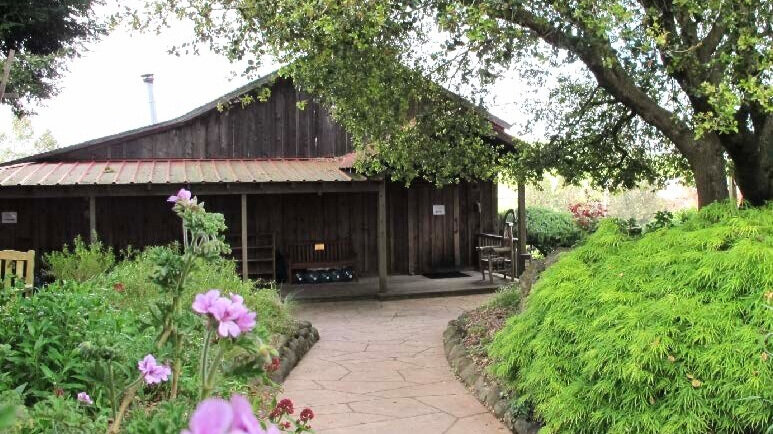
Aikidoka, Friends, Relatives, Supporters of Two Rock Aikido Dojo,
Aikido, as conceived and developed by OSensei, Great Teacher, is a martial art whose goal is to unify humans with the power, wisdom, and compassion of the Universe. OSensei said that Aikido came to him from the Kami (Gods) to bring human beings together as one family, and to assist everyone in completing their mission on earth. He opened his art to the entire world, regardless of race, gender, ethnicity, class, ability, or sexual orientation. OSensei said,“Non-violence is the true practice of Aikido.” This is what we practice at Two Rock Aikido and we stand in solidarity with every person to Iive in their full dignity, safety, and belonging. In this historical moment of sorrow, grief, anger, and immense possibility we align ourselves arm in arm with those who seek to transform this injustice into a new world.
We will donate 20% of the June Member Tuition to BlackLivesMatter.org
Take It Easy But Take It
Richard Strozzi-Heckler, Dojo Cho, Two Rock Aikido Dojo
Make the Blend, Not War
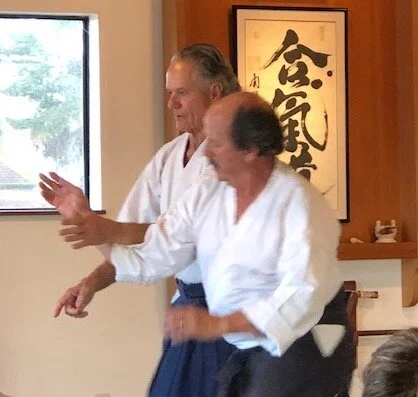
As Covid-19 migrated from a bat body to a human body then accelerated to the global body our historical conditioned tendencies predictably came to the foreground as our fatigued, out of date metaphors of war. “We’re in a war;” “This is combat;” “We will destroy the enemy;” “We’re in a battle for our lives;” “We need to be on the attack.” This is a narrative of fear, the threat of the other, and our inability to deal with uncertainty, that masks the opening that this pandemic offers. As shamans, curanderos, alternative medicine communities have voiced for millenniums: it’s not a disease, it’s a healing crisis.
From this optic we could say that Covid-19 is not an enemy to war with but a guide who shares a web of interlocking, interdependent, ontological, and cellular relationships with us; an intelligent, powerful life force that is not only looking for a host in which it can photocopy it’s RNA, but acts as a projection screen for our present state as a species, and the conditions we’ve created on the planet.
King Covid, as I’ve heard it called in some neighborhoods, has heralded an initiatory moment for the evolution of our species and the planet. We have the opportunity for designing a future different than the one that we’ve been blindly entering. Traditionally, initiations involve a struggle that overcomes an obstacle. It’s a surrendering of the old and an embracing the new. A romantic view perhaps but a journey that exacts sweat, blood, and a rigorous look into the mirror.
In Aikido, a Japanese martial art, and in the somatic discourse, there’s a central tenet and practice we call making the blend. This means that when we’re under some kind of threat, real or perceived, we take a moment to first center ourselves, noticing how we might be triggered and out of balance, and then we blend with, join with, the incoming energy. In Aikido it’s using the energy of the attacker to neutralize their aggression, instead of neutralizing the person (read: go to war), bringing the confrontation into a harmonious reconciliation, instead of a zero sum game of winners and losers.
In the social context we can blend by embodying an open hearted curiosity and authenticating the other’s reality; to see their point of view. We may not agree with them, we may even be repulsed by them; but by opening ourselves and acknowledging the conditions that shaped their reality we also open the possibility of a future different than harm, cruelty, poisoning our water and air, dropping bombs. Some might call this compassionate wisdom.
What I’m suggesting is that using the metaphors of war in this pandemic are also infectious. Stories infect our nervous system; narratives infect our spirits. The metaphorical virus of violence may be what brought us here in the first place. When we take the shape of aggression and violence we are predisposed to fear, anxiety, and panic. To make the blend doesn’t mean we don’t heal and cure and find a solution for ourselves; it doesn’t mean we capitulate or give up our position; it doesn’t mean we can’t fight for what we care about. It means we recognize our interconnectedness with life, and choose a path that is an affirmation of life. We’re able to see past our deeply conditioned strategies for survival, to see beyond our lifetime and into the future of our children and grandchildren.
Try it for a moment: Take the shape of fighting, of destroying the opponent. Fists clenched to hit; jaw set to protect; crouch and round the shoulders.
To be less of a target, narrow the eyes, head forward of the chest; the breath is high and short. Now take shape of making the blend, of listening to the life energy that flows through all of us. You’re upright in harmony with the downward pull of gravity; your hands are alive and relaxed for optimum choice of action; your eyes are relaxed, you have a panoramic vision; your legs and feet are connecting you to ground; your breath is low and rhythmic.
This is something we can practice. It’s a choice we can make.
Making a blend with King Corona at a molecular, cellular, interpersonal, social, and ecological level is asking us to see our co-dependence with it; that we reflect on how we are projecting our profound panic on this virulent form of life, and how we have invited it in. Richard Preston, a scientific writer of fiction, non-fiction, and screen plays has studied viruses and epidemics for decades, traces how viruses often emerge from the degradation of ecosystems, particularly savannas and tropical rainforests. He explains how viruses in a damaged ecosystem tend to mutate and adapt quickly, that “viruses leaving a non-human host crashes into a human host like rats leaving a ship”. Since we are the authors of our environmental crisis can we own that perhaps we actually invited the virus into our midst; can we see that the genocide of indigenous people is a virus; that our fear is a virus? Now we are being asked straight up to examine the consumer chaos of late stage capitalism, the economic hardship of the poor, the racial divide, the social inequity. These are questions of leadership. The mirror of King Covid reflects that our current leadership is infected with a virus of aggression and fear: brittle, self-serving, contracted.
From the perspective of the blend the metaphors and narratives of war are limiting, if not harmful. If we choose to look from the bigger picture, then we must blend with what King Covid is guiding us to. But don’t get me wrong: Blending also means giving our heartfelt gratitude and help to the first responders and healthcare workers; extending our compassion and help to those who are ill, to those that have lost loved ones; to assist those who are under severe economic hardships; to respecting social distancing, washing our hands, and use sheltering as civic duty as well as an extended moment of a spiritual refuge.
Let’s make the blend and not war.
Take It Easy, But Take It
Richard
Report #8 From Abyssinia: Completions and Beginnings
Last night we had a festive outdoor celebration at Amadu Hotel where the Elders were staying. A sheep was slaughtered, butchered, and cooked on an outdoor fire served with traditional Ethiopian food and beer. The One Love Band played late into the night. The two Marines from the Embassy detachment who were training at the seminar were there and still dancing when I left. One of the Elders came out and danced with Tes while everyone cheered wildly. Now at the morning completion training there’s loads of good will, smiles, and hugs with new friends accompanied by red-rimmed eyes and a bit slower than three days ago.
Tes bows everyone in to begin the final session, Linda Sensei follows, and I teach last and bow us out. The East African Aikido Seminar is complete. Tes delivers a passionate, moving speech about the importance of this event at this time in Ethiopia, how aikido has taken root so quickly in the youth culture, and the promise it holds for a different kind of education for its society. He acknowledges everyone who made this seminar happen, with a special bow to the Elders and their participation.
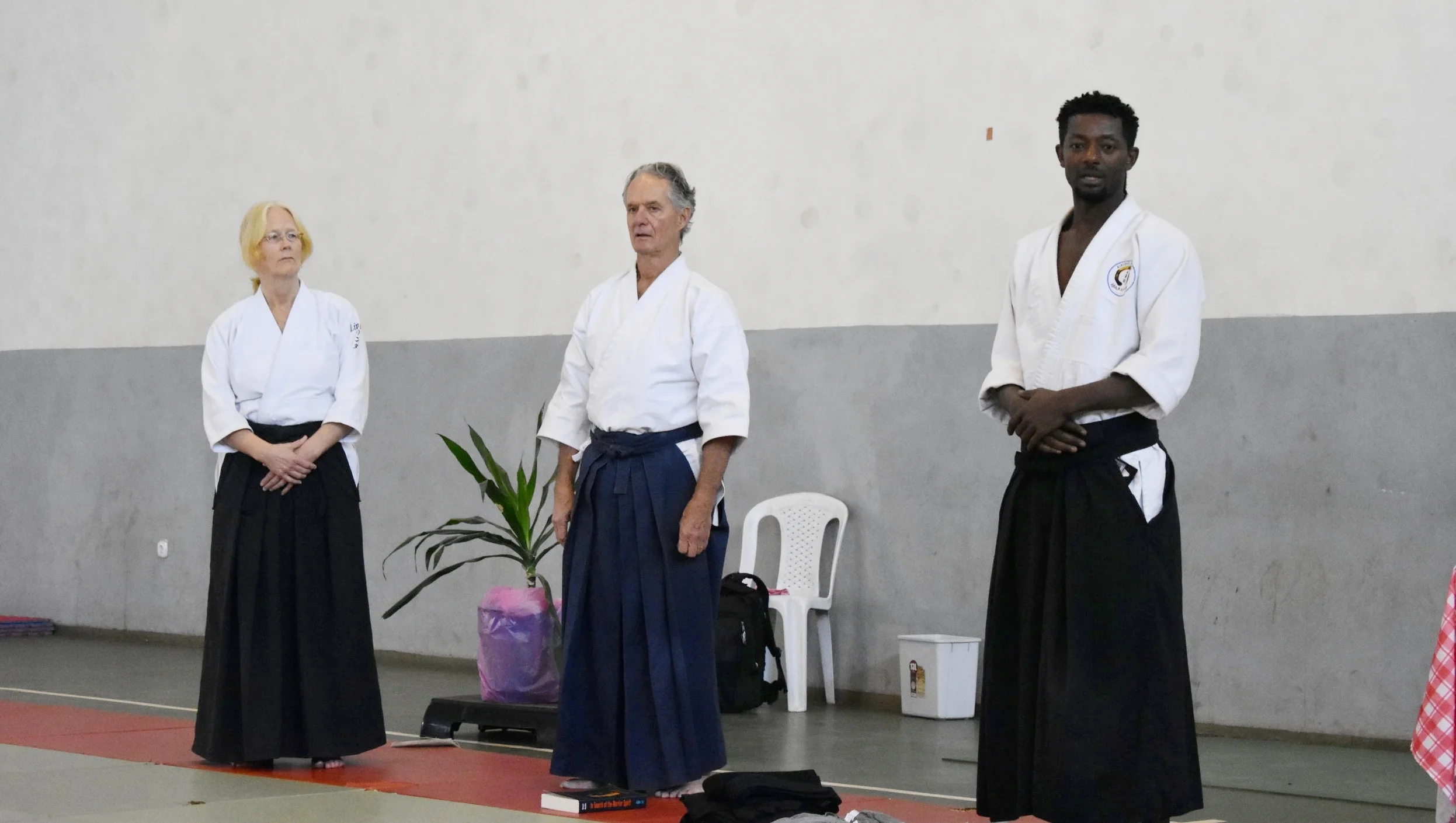
We then hand out the shoshus (diplomas) to those who had passed their tests. He then brings out two large framed goatskins with O Sensei’s likeness painted on them with Amharic written in the national colors, and hands them to Linda and myself. They are unique and original and beautifully painted and draw a gasp from the group. O Sensei’s eyes are alive and seem to look out from some ancient place of knowing. I wonder if he even knew where Ethiopia was, and did he imagine that aikido would grow deep roots in the Horn of Africa. Tes then presents the Elders with a beautiful framed photo of the group. As they step to the mat to receive their gift three of them come to their knees and bow formally to Tes as we do in aikido. It’s a sincere gesture and a deeply touching moment. It exemplifies all that we have envisioned that could occur here: a coming together to create, at least momentarily, a unity of heart, mind, and action that could be a model for a society committed to equity and reciprocity. I am tired and I know everyone else who helped make this happen is tired, yet we also know that this completion signals a new beginning.
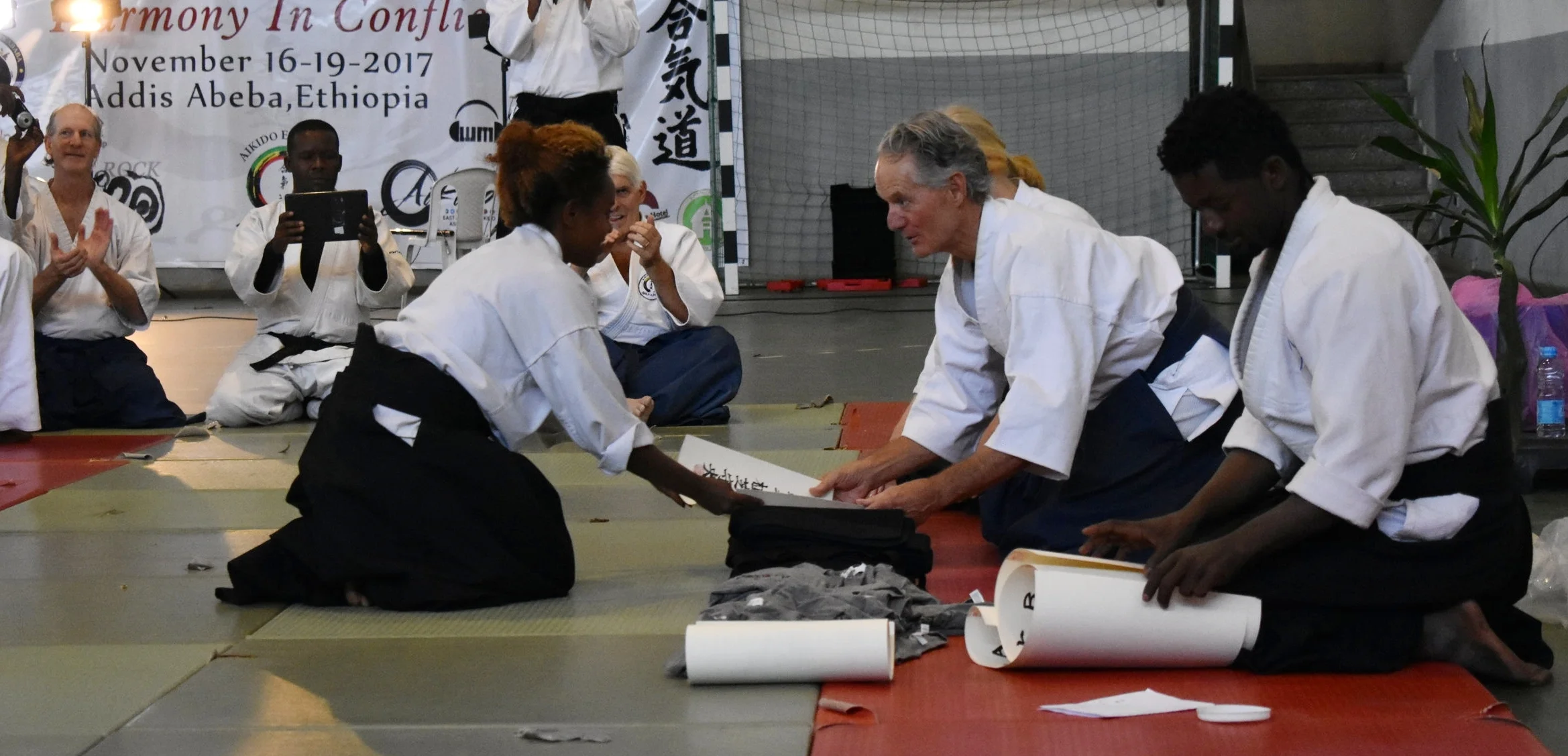
Then the saying of many good byes and hugs and everyone pitching in to disassemble the dojo and return the Ras Hailu Gym to its former state which we know in our hearts will never be the same again.
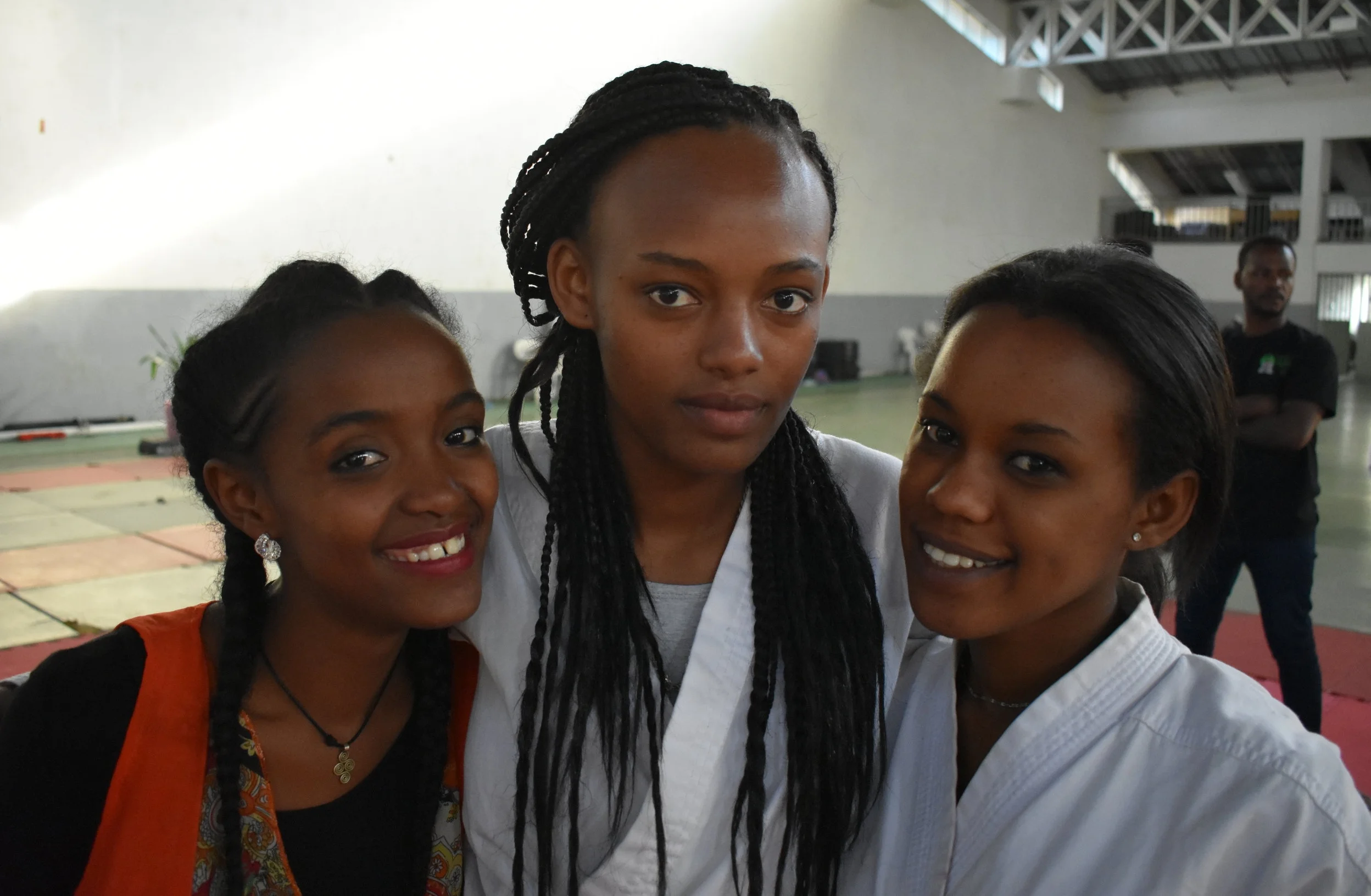

The kit of pigeons sits in the rafters above peering down as we depart the dojo for the last time. Instead of taking the shuttle back to the hotel I walk back with David Weinstock and Tom Lutes as a way of integrating the intensity of the last ten days. I feel refreshed stretching out in the hectic streets and equatorial sun, letting in the success of our efforts and letting go of the trials.
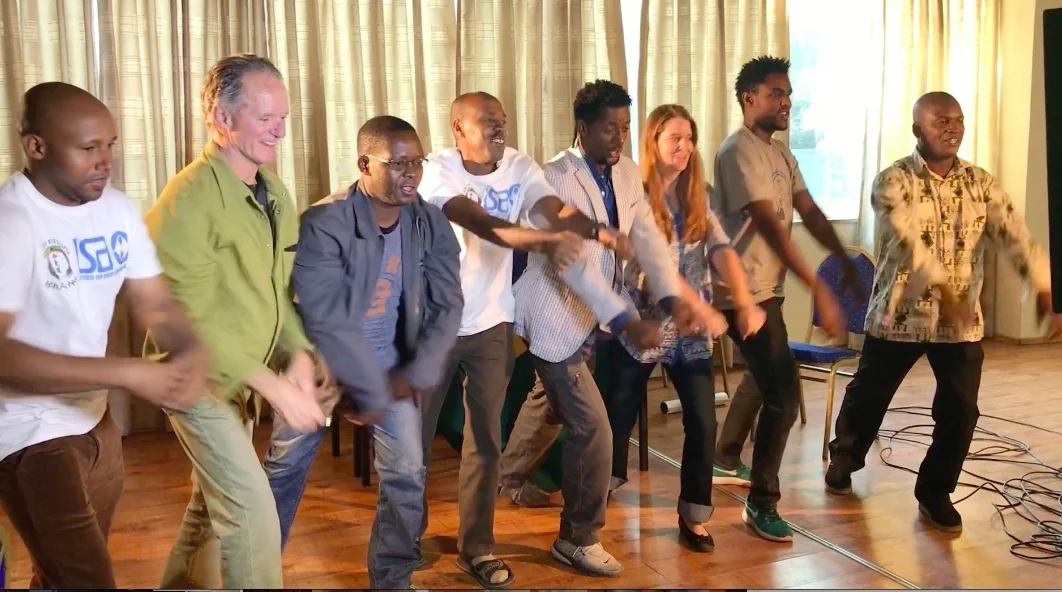
When we arrive at the hotel I receive word that Tes is in the upstairs meeting room convening with the representatives of Kenya, Tanzania, Zanzibar, and Somalia having conversations around the formation of the East African Aikido Association. As I enter the room there are wide smiles on their faces as they as lean over a Memo of Understanding document. They look up and present the signed memo stating that we are collectively moving forward in inaugurating the East African Aikido Association. Another momentous occasion that is met with hugs, high fives, fist bumps, and all of us doing the Happy Dance (see video at top of post). We are happy and satisfied and as the seminar completes the Association begins. Completions and Beginnings. I’m sure we will dream the Happy Dream tonight. Together we can make a better world.

Take It Easy But Take It
Richard
Report #7 From Abyssinia: Cultural Exchange Day
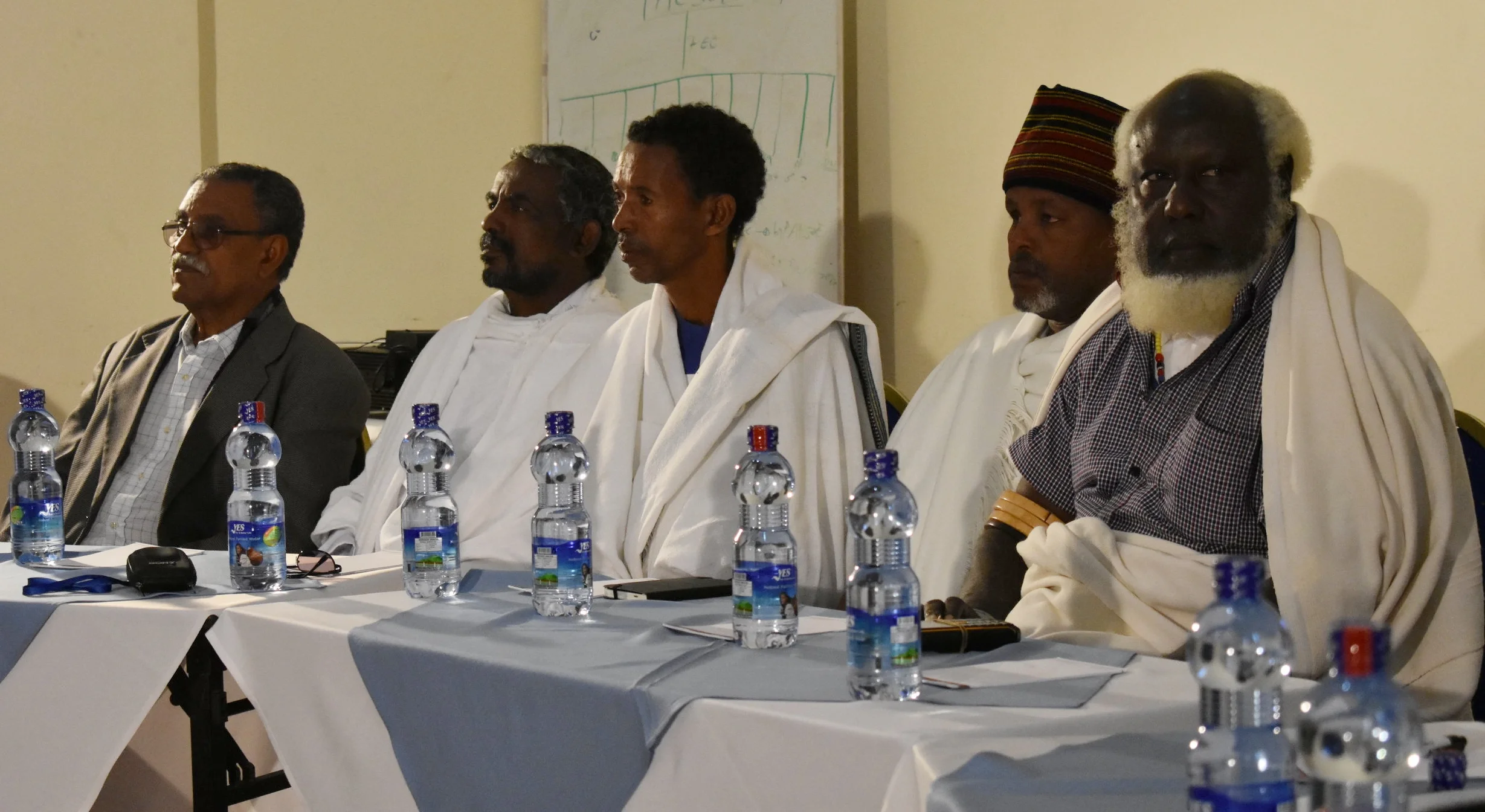
The formal Cultural Exchange meeting is held in the large conference room of our hotel. We’ve arranged a semi circle for the Elders, Tes, Linda and myself to sit, and rows of chairs for the seminarians facing us. Tes recommended that the American men wear suits and the women wear long skirts or a pantsuit as a sign of respect and acknowledgement to the Elders, and the formality of the event. The Ethiopians and other Africans aren’t in suits but have clearly upgraded to the next level of finery. Looking around I realize I’ve seen almost all these students with only their gis on and it takes me a moment to recognize them in their “civilian” clothes. Their bright, eager faces beam expectantly. Their expressions clearly show that training aikido with the Elders of the major tribes present is something they probably never imagined, and now it is unfolding before them; there is awe, curiosity, and hope radiating from them. A film crew is busy setting up arc lights and cameras to record the event to be made into a film, as well as sent to the Ethiopian television studios for distribution. The room begins to fill with a quiet, electric anticipation.
Without announcement the Elders enter the room and everyone comes to their feet and begin clapping in unison. They are stately and elegant in their tribal robes. Abu Geda from the Oromo tribe blesses the event with his deep baritone. His voice is somewhere between a bark and a growl that rumbles out of some deep, ancient cavern. It’s like a powerful wave cascading through the room, the incantation taking hold of my body like a rough friend hugging me.
We all sit and Tes welcomes everyone speaking first in Amharic and then English, the translators translating simultaneously in Swahili and Oromo. Highlighting important events Tes tells how it all began when Don Levine introduced him to aikido at the Hawassa Youth Center; his first time out of Ethiopia flying to Nicosia, Cyprus for the Training Across Borders seminar where he and I met; arriving at Two Rock Dojo as uchi deshi (live-in student) where he earned his shodan and also attended the courses in Embodied Leadership at Strozzi Institute; his return to Ethiopia to open up dojos; my visit to Ethiopia two years ago to teach and promote six shodans and four first degree brown belts; Tes subsequently returning to Two Rock Dojo earning his nidan and sandan; his work developing eleven active Dojos in Ethiopia and more. When he announces that three days ago Aikido Ethiopia received the official stamp of registration from the government, the crowd erupts in jubilant shouts and applause. Tes’ story is an exhilarating ride through the last twelve years of Aikido Ethiopia history. Each section evokes particular images and memories and I feel grateful to be part of this social movement. So much has occurred in the last thirteen years and I am privileged to be a participant and to have developed this relationship, this musubi, with Tes, and the aikidoka of Ethiopia. In some ways it seems like a blink of the eye, other times I feel the granularity of it in my bones, a long and sweeping passage through a landscape that is still being traveled.
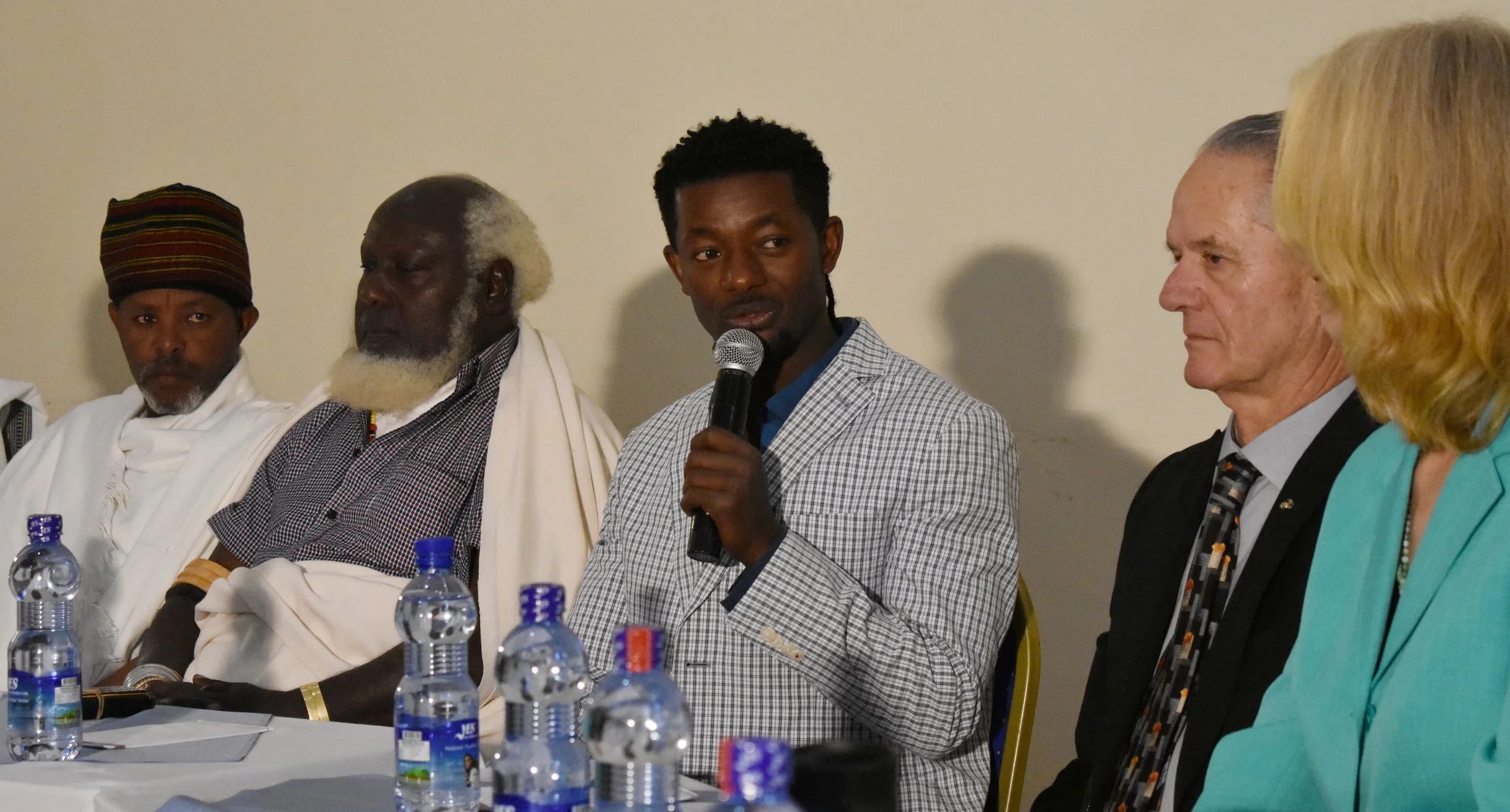
I stand and tell the story of O Sensei, the founder of Aikido, and how his spiritual awakening turned a powerful martial lineage into an instrument of peace. His declaration “…budo is to bring people together, not to destroy each other” is an ambitious proclamation that is entirely relevant in the 21st century for individuals, organizations, and nations. I then speak about the foundational principles that are learned through the practice of aikido. Yes, it is a powerful martial art in which we learn to defend ourselves, and to defend those who are unable to defend themselves. And, perhaps even more important is that we are developing an alternative response to our instinctual reactions of fighting, fleeing, freezing, or disassociating when threatened. This alternative is called blending in aikido or musubi: tying in with our partner so that their aggression can be neutralized without harming the aggressor. I then demonstrate this with tai no henko, or blending practice, with Tes. By practicing this principle somatically it will be embodied and therefore available to us in the social, interpersonal, conversational space. In other words it’s possible, through aiki practices, to create a society that has alternatives to conflict that are not violence, war, or being in full submission. By acknowledging and listening deeply to the concerns and realities of others we open alternatives to fighting and hostility.

At this point the Elders speak. One at a time they describe how their tribes have traditionally dealt with conflict. It’s a rich, complex heritage that goes back to ancient Abyssinia. As they speak I look into the rapt faces of the audience. Once again I realize what a significant, historical moment this is for these young Ethiopians. For the first time they see these Elders and their representatives in the same place at the same time, sitting together having a civil, sincere conversation about alternative ways to resolve conflict. How simple this sounds-and it is-yet for this moment and for these young people it’s a reality that they’ve never thought possible. They’ve lived their entire lives with armed strife in their country and never thought that these Elders would sit together in a setting like this. I can’t imagine what they’re thinking or how they’re processing what they see or what is being said. What I do see is an intense focus, their bodies rapt, leaning forward with an open-heartedness. I remind myself that for them to simply have this image enter into their psyche has the possibility of opening new doors.
Here are a few of the points of the conversations and questions and answers from the audience:
Before resolving the conflict “the blood must dry first”. That is, end the bloodshed first. No reprisals, revenge, payback or solutions until there is restorative justice and healing.
The transgressor will have to leave the village and/or tribe. In a collective society this is a serious ban. The exclusion itself is a sentencing. Until there is justice they do not have any of the benefits of the tribe. This banishment also has the consequences of the threat of wild animals and opposing tribes if they are in the bush.
At some point the transgressor and the victims come together and the transgressor will take accountability for his/her actions and say what new actions need to be taken. The victims will choose to forgive the transgressor, or not, and ask for the reparations they require. Often an animal, a sheep or goat, will be cut and the blood will fall onto the ground. The victim and the transgressor will step over the line of blood as a symbolic gesture that no more blood or crime needs to occur.
The Elders all agree that this seminar is a good start in reconciling differences, but at this point it’s like a teaspoon from the depths of the ocean. We have to continue and to go deeper and sustain what is initiated here.
One elder from Amhara in giving an example of resolving conflict used the example of two men having a conflict around choosing the same woman. Rudy who had just earned her nidan rank a few days ago asked, “Are you saying that the woman doesn’t have the choice of what man she can pick?” The oxygen seemed to be sucked out of the room followed by a deep hush. Knowing we had landed on a contemporary and controversial subject there was a deep out breath and everyone turned to the Elders. Then an Amhara Elder replied in a grounded, centered manner that it used to be that women didn’t used to have these rights but now it is changing. Furthermore, they were actively engaged in this issue and his example was something from the past.
A young woman who had just earned her first degree brown belt and a third year medical student asked, “How do you think we are doing? Are you proud of us? What do you think of this generation?” An Elder from Tigray replied immediately “I give you 75% approval and 25% not so good.” Almost immediately an Elder from Amhara reached for the microphone and said, “I say 50/50. I approve of your thinking and outlook but I’m very concerned because you always have machines (cell phones and computers) in your hands and the way you dress is separating you more and more from the earth. This is a problem.”
The Elders asked the audience, “Tell us what you need. Remember we need to learn from you as well. Our leadership comes from listening to you.”
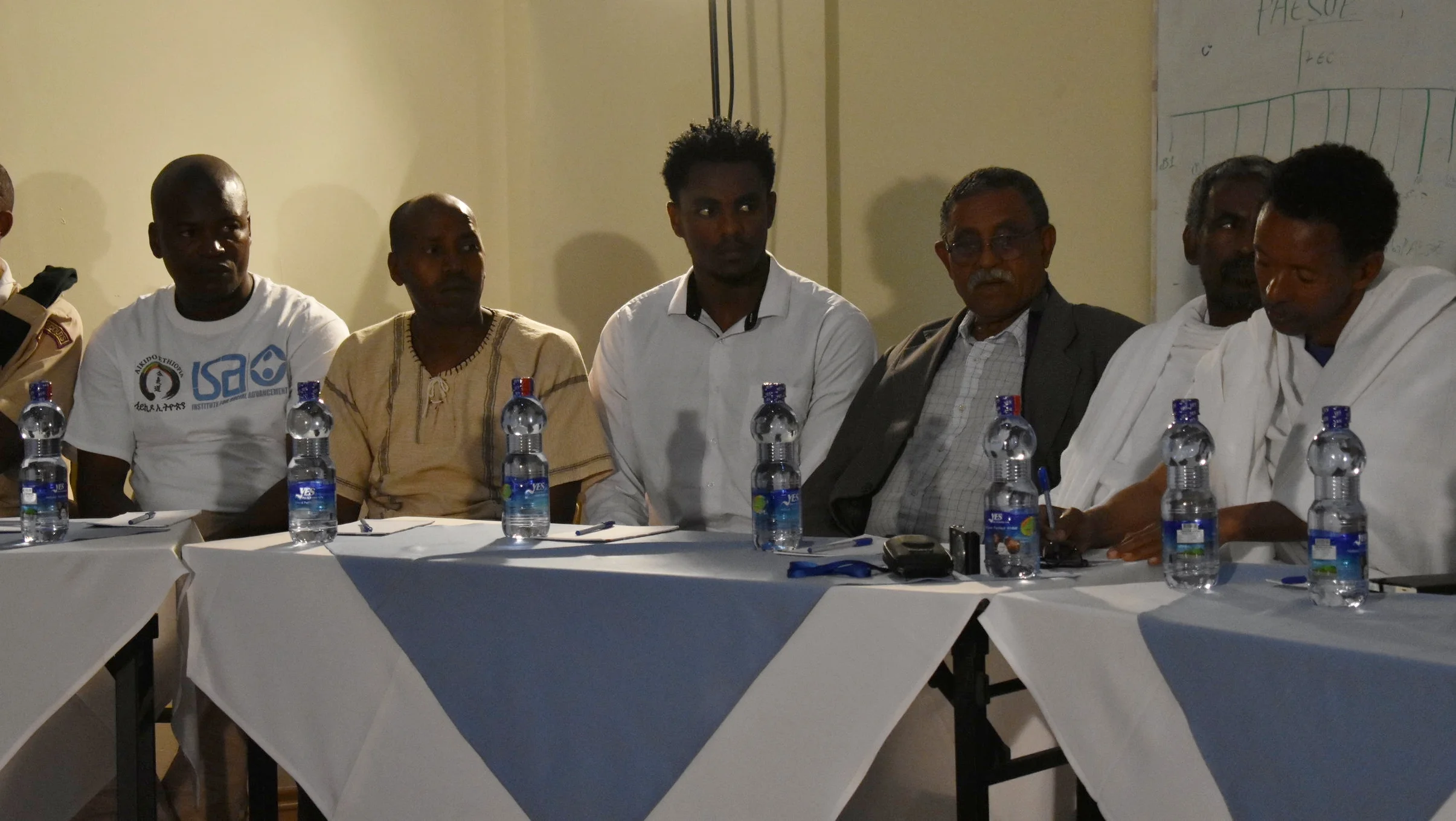
Alan Vann Gardner asked what advise they have for westerners in developing Elders in our society. The Elders then outlined the path of becoming an Elder. Based on the ethnic group there is a path for women and one for men. Tribes have different processes based on their own system. For example in some tribes one can become an elder based on his/her wisdom and how he/she lives his/her life. The way they treat people will be the deciding factor to identify him/her to mediate disputes and represent the society. In other systems the path of Elderhood takes forty years and every eight years they’re evaluated by the tribe.
The Oromo Elder, called Aba Gada, said it takes 5 stages to become Aba Gada, and at every stage they will be evaluated by other Elders to pass, or not, to the next level. Elders from every tribe will start teaching young people leadership skills at a young age and pass on to them what is required to be an exemplary leader. Every member in the clan has an opportunity to become an Elder but from the beginning they start looking for those who seem gifted in the leadership arts. The Elders will keep vetting the candidates without them knowing. Since not all will become Aba Gada, those that are not elected to go on will become Elders in the stage they just completed; in other words there are full Elders at every stage. Also, even the last one who is nominated can be dismissed right before he becomes Aba Gada if the Elders find out that he has not been fair to his spouse, family or in his tribal life. He then returns to becoming a member of the society.
The rigor, standards, and embodied interdependence that are exacted on this path of Elderhood are impressive. How sound this seems especially when I think of our current leadership that seems more intent about creating divisions in people, generating fear, acting from greed, building fat bank accounts, and saying whatever is needed to hold on to their jobs. It’s the difference between being a politician and being an Elder leader. I’m not romanticizing this perspective but rather see it in sharp, painful contrast to our ways, and imagine what it would take to legitimatize a path of Elder/Leader in which wisdom, compassion, and skillful action are the determining factors.
That evening we had a small intimate dinner with the Elders and their representatives; one of the representatives was Tes’ mother Alemitu Asura. At one point they said, “This is a very important event. This is the first time that we have ever been in the same room together and it’s important that we are talking and we need to keep doing this.“ One Elder from the North pointed across the table to the South Elder, Oromo Aba Gada and said, “There is much that I am learning from you that I will take back to my tribe.” That moment felt like hitting the target dead center. I could feel our team inwardly smiling and thinking about the happy dance we were going to do.
Richard
Take It Easy But Take It
Report #6 From Abyssinia: First Night: Opening New Vistas
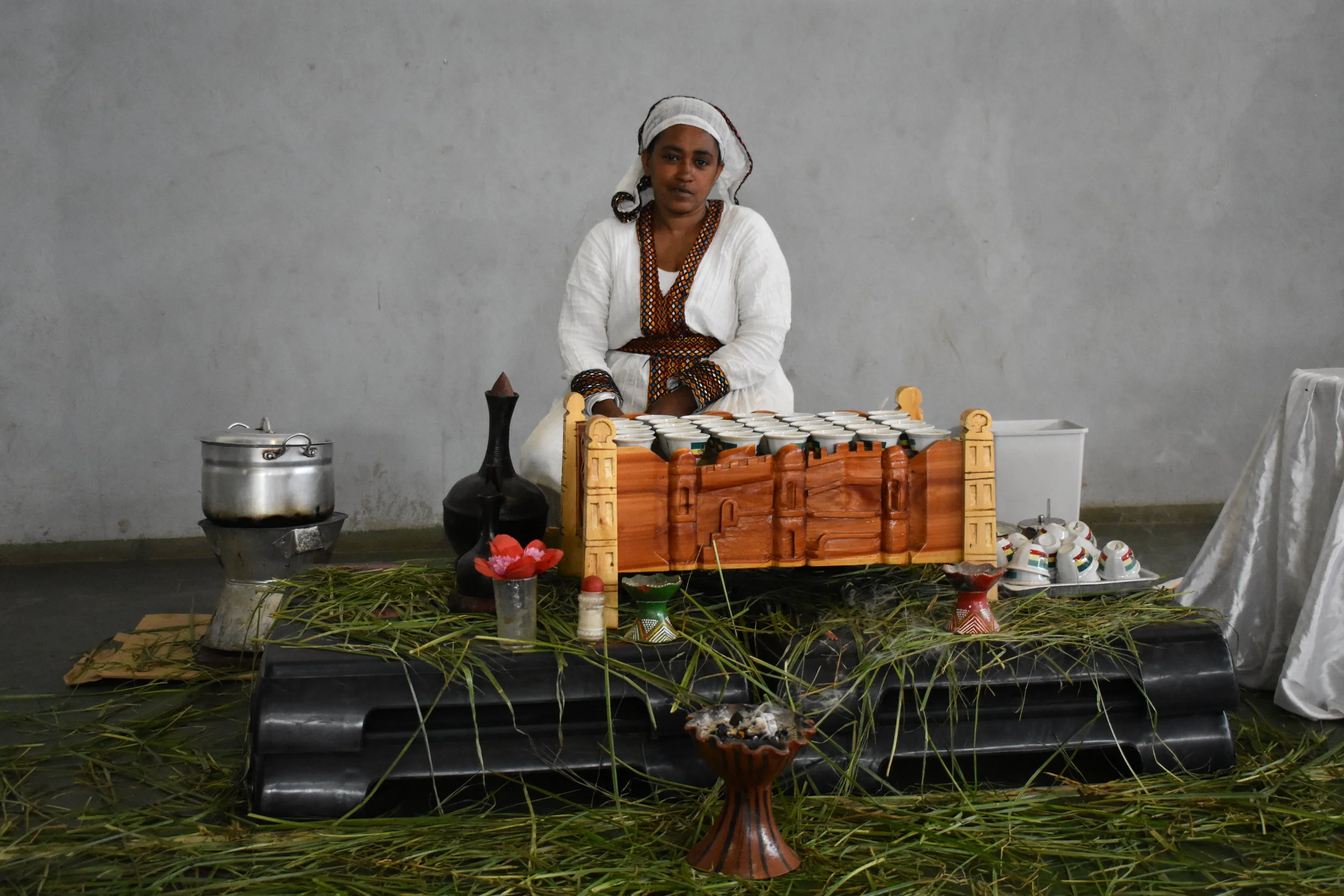
The first day of the East African Aikido Seminar is packed with last minute details and adjusting to the endless stream of changes: flights from Kenya and Djibouti are cancelled and need to be re-scheduled, visa problems for Tanzania students, finalizing room and board assignments for out of town students, transportation for westerners from hotel to facility and back, the truck bringing the mats has broken down, new negotiations needed for the facility fee, bathrooms don’t work in the women’s dressing room, and on and on. This doesn’t indicate that planning and plans were left to the last minute; our team and Tes’ Ethiopia team had spent countless hours mapping this out. It’s just that we, the ‘we’ being us westerners, are receiving first hand training in the old saw that the map is not the territory…no matter how good you are at Google spread sheets life takes over, especially in the mysteries of Abyssinia. Tes and his team move fluidly from one breakdown to another without panic or hysteria, the spirit of aikido ever present in the way they blend with change.
We set the Dojo up in the Ras Hailu Gym which is about a 15-20 minute drive from our hotel depending on traffic, and a 45 minute walk depending on how much time you want to absorb the street culture. The cavernous gym has not yet officially opened and the seminar will be the first to initiate it, except for a loft of pigeons that have already taken up residence in the upper rafters. As the evening unfolds four unplanned and distinct inflection points spontaneously occur, reflecting the future shape of aikido in East Africa.
First, before the seminar begins a woman in colorful native dress regally officiates the traditional Ethiopian coffee ceremony just off the mat. There is a brazier with heated coals billowing clouds of frankincense along with the aromatic richness of Ethiopian coffee wafting across the dojo; cut marsh grasses are spread along the floor. Whenever you enter someone’s house in Ethiopia a coffee ceremony will take place in your honor. The aikidoka from across East Africa and America are being honored in this ancient way. To her right is the One Love Band playing Rock and Roll, Reggae, Pop, World, Ethio jazz, and contemporary Ethiopian music. Tes has lived and played with these musicians since he was a teen-ager in his music studio in Hawassa and they were original members of the One Love Band and Theatre group and the newly formed Aikido Ethiopia a decade ago. Now they are famous throughout the country and have come to play for us on opening night and for the party we will have two nights later. This is an eye-popping first for the beginning of any aikido seminar anywhere, and it signals this being truly an African event run by Africans.
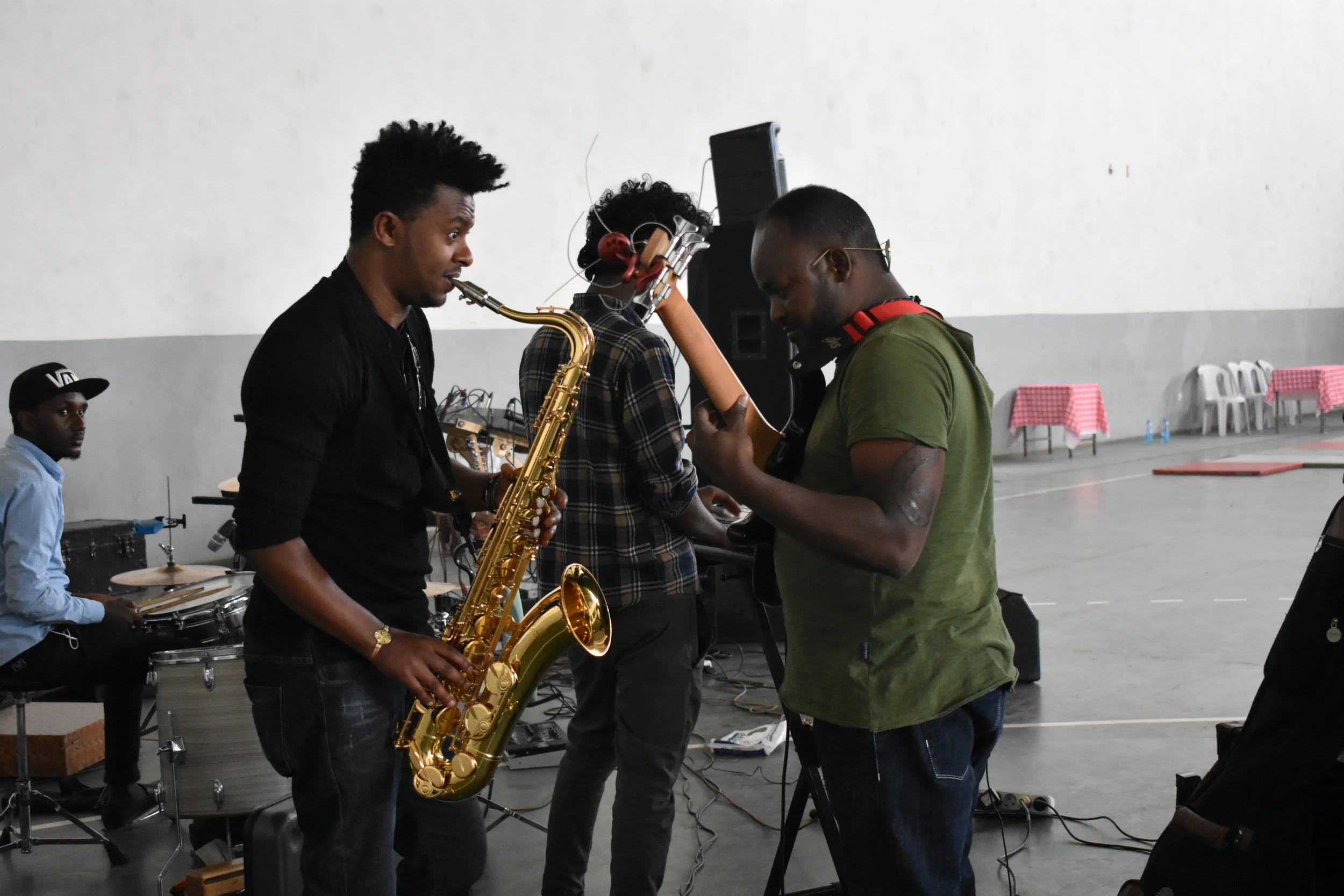
Second, the elders are late and we are not sure why and not even sure they will appear. As we collect to revise our plan people spontaneously step on the mat and begin to train with each other. There is no formal bowing in, or a teacher leading, or an announcement about a change in time, or any customary protocol at all. It’s as if the mat is a magnet collectively drawing all the aikidoka into a whirling, dynamic spiral where they begin to joyfully and collaboratively practice together. There is a grace and beauty present that is moving us without instruction or the usual formalities of how a class or seminar should be conducted. This is a collective energy shaping us that is larger than all of our plans or considerations. The incense and coffee filling the air, the music guiding our pace and rhythm, the pigeons gliding overhead, students laughing, tumbling, pinning each other as if governed by forces that are unsaid and unseen, where a spirit of oneness truly becomes a living reality. There is rigor, love, and a deep pulse that is moving through the entire Dojo. I squeeze the trembling in my eyes so the tears don’t roll and say to Tes, “It’s happening. The seminar has begun. It’s bigger than us now.”

The third inflection point is probably the most significant and the one that will most likely, and hopefully, have the largest influence. Without announcement or display the five Elders quietly enter the Dojo. Everyone in the room stops what they’re doing and stands and turns to them and we all clap in unison as they walk in. These are the elders and their representatives from the Amhara, Oromo, Tigray, Sidamo and Kore tribes. They line up facing the students and guests and the Aba Geda from the Oromo tribe blesses the seminar with a chant that fills the entire space and sends chills up our spine. This is radically significant in that this is the first time that the younger generation sees these tribal elders all in the same place at the same time. It’s a monumental historic first. This was Tes’ brilliant idea when he saw the opportunity for a new image being presented to the younger generation of these tribes who are all present tonight (remember that over 65% of Ethiopians are under twenty-five years old). This generation and previous generations have never thought it a possibility that these leaders would all come together in a cultural exchange. In addition Tes, and Demelesh and Tariknu are from traditionally warring tribes and they themselves also present this model of working and creating together without animosity. We framed this as a cultural exchange so we weren’t simply showing the virtues of aikido in creating a more peaceful society, but learning from these Elders how they have historically dealt with conflict. Furthermore, this was the first time that these elders had ever been in the same room together. This was new to them as well. This was just the beginning as the next two and half days and nights we would be sharing the same space allowing this image to find fertile ground to grow and flourish in our psyches. The Elders then seated themselves behind a table and watched us begin the inaugural East African Aikido Seminar.

The fourth inflection point arrived when a black out occurred during Linda Holiday Sensei’s class. The darkness was immediate and we could barely make out the figures moving in and out of the gloaming. Linda moved gracefully with the situation presenting it as a practice of blending yet cautioning everyone to be even more attentive. There was a real concern that someone might inadvertently get hurt. We continued but moved slowly when inexplicably a shard of light appeared and then a bit more and then it became apparent that all the visitors, including band members, were standing at the edge of the mat pointing the flashlights from their cell phones at the mat. A globe of light appeared at the center of the mat from this collective spirit. No one lead it, there was no instruction of what to do, there was no one organizing it, but rather there was an energy that began to move everyone into a positive, generative action that served the whole. Then someone opened the doors and shined the headlights of a car into the building. While the rest of Ras Hailu Gym was in darkness a luminescence emanated from the mat.

There was an emergent process that become apparent when everyone spontaneously began training without a declared beginning, and then again when people stepped forward unprompted to shine their flashlights into the darkness. It made me think of the fireflies on the Mae Klong River in Amphawa, Thailand that blink on and off in unison without any central, hierarchical command. There is a nuanced, powerful force that occurs when a group of committed, bright people in a shared practice, all face downfield together. Those of us on and off the mat were doing aikido in both manifest and hidden ways, moved by the music of a deep song of creation. What would it be like to have a community, an organization, a nation that evoked this living, embodied emergent process that organized life towards affirmation and generativity. When Tes bowed in to teach after Linda the lights suddenly came on with whoops of laughter and somehow signatory that this was a seminar to be led and taught by Africans guided by the ineffable power of aiki.
Report #5 from Abyssinia: Test Day
I wake with the morning call to prayer from the muezzin in the mosque across the street. The thin rind of the moon, detached and milky, floats in the inky sky. The air is still and unmoving and below in the streets figures emerge quietly out of the darkness; the outline of the Intoto hills, as though cast in iron, appears like some ancient anvil silhouetted in the eastern sky. Verreaux’s Eagle, or Amora in Amharic, circles silently in the breaking dawn; this calm is a coin to be spent with care. So I heed the muezzin’s call and in the mosque of my body I do my sitting practice and after reflect on the day to come.
Since my visit two years ago the aikido students throughout the eight Dojos in Ethiopia have been training conscientiously with Tes who visits two to four times a year, with Lou who teaches when he can find time from his commitments at the hospital twice a year, and most consistently with the Ethiopian black belts, Demelesch, Rudy, and Tariku, who I tested for Shodan on my last visit. This test will include four 1st degree brown belts (the test before Shodan), two Shodans and three Nidans (second degree black belt). There is high anticipation and students are arriving from throughout Ethiopia to attend the tests and take part in the East African Aikido Seminar.
The Juventus Sports Club, where the tests are held, is behind Meskel Square, which is in the center of the city. Surprisingly it’s an oasis of trees, gardens, and a large stone outcrop with seeping water from above darkening it. I breathe in the cool clean air buzzing with life; there’s a radiant energy commensurate to the small dojo at the back of the building. Overhead are the usual African Buzzards, Vultures, an occasional Verreaux’s Eagle, and darting just above the trees a Black Kite called Kura in Amharic. At last count there are seventy-two raptors in Ethiopia, thirty-one migrants and forty-one residents. Myself, along with the other westerners attending the seminar, are also the migrant species. Our whiteness makes us easily recognizable; we are as much ignored as we are seen as a possible easy mark for a donation of one kind or another. To be a migrant is by definition to rove, to wander, to move with the seasons. What is the kinship between the migrants above who are cutting pathways in the sky and us humans scoring countless pathways on the earth with boots and fire? The way the raptors effortlessly carve the air remind me of the sweeping spirals in aikido that bear your partner into a joined reality; and the steep, reeling dives of the Kura are like the fiercely loving entering moves that we learn as a remedy for an aggressive attack. Perhaps it is this similarity of shapes we share that’s the link between us human migrants to the migratory family in the blue skies of Addis Ababa. These spirals, both broad and sweeping, and tight like curled fists, are the reflection of the music of the spinning galaxies that move us. In chemistry migratory is distinguished as the movement of ions toward one electrode or another, under the influence of electromotive force. Is this roving of ions, deep within us, authored by a force we call intent? If so, then it is our moral imperative that we summon the question of what is our intent? What is it we choose? Or how do we let it summon us, to choose to move through us. The spiritual aspect of aikido asks us to be moved by an energy, a Divine electromotive force if you will, what we call Takemusu Aiki. This force influences us at a cellular level, as well as at a Universal level, as an emergent, embodied, evolutionary process of interconnectedness and interdependence…OK, let’s call it Love. Then there’s the art of aikido migrating to Ethiopia in the here and now, merging with its complex and rich Abyssinian culture. There is a future we are constructing in these shared spirals, but we have only glimpses as to what new life they will bring.
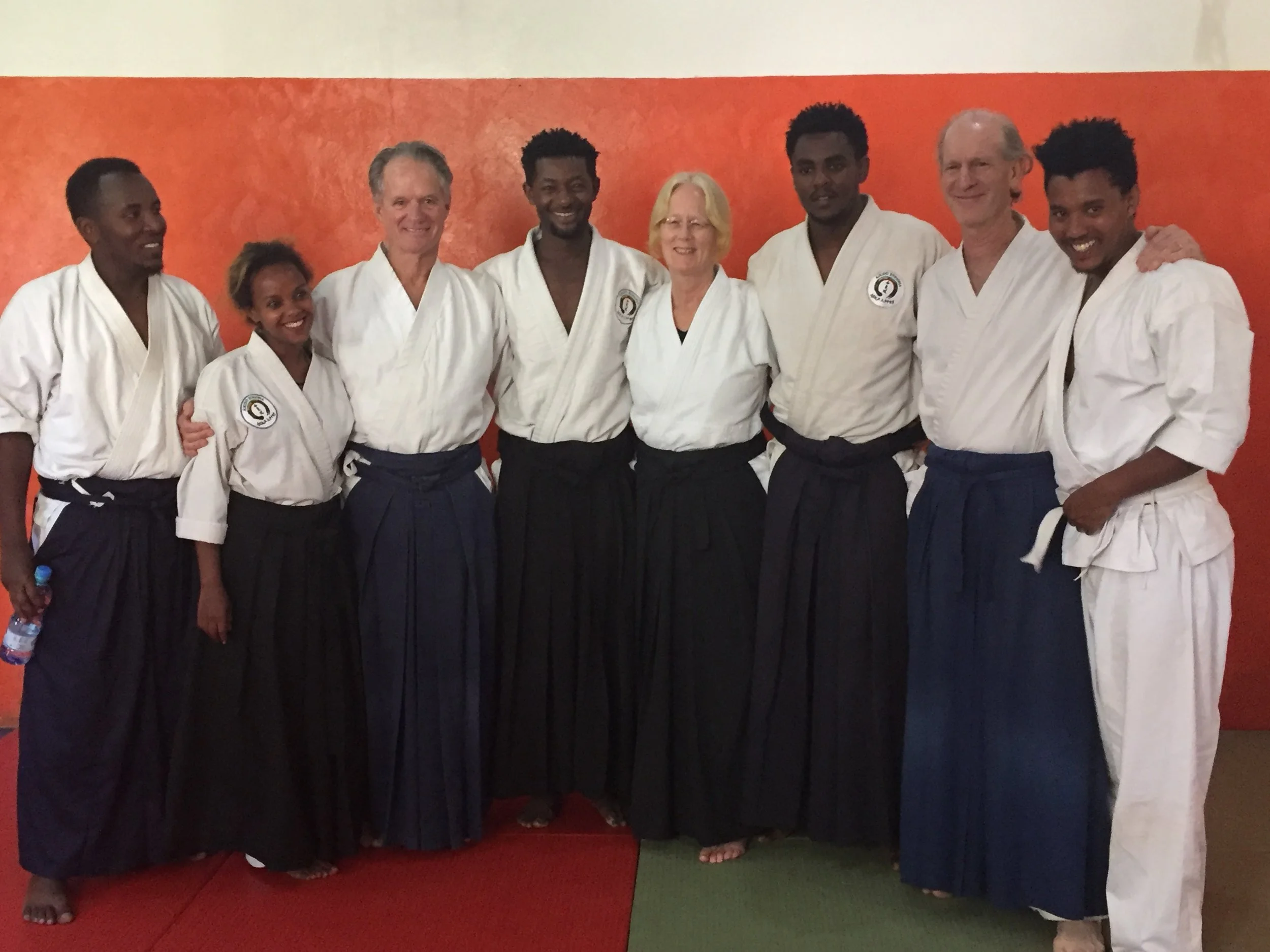
The Aikido Dojo at Juventus Sports Club is shared with the Addis Ababa Judo club. It is approximately 225 square feet, the size of an average living room, with tatami mats and half the wall painted a festive orange and the other half a linen white. Forty dedicated, energetic, sincere, joyful, rollicking twenty-year olds roll and fall, stretch, swing jos and bokkens, apply wrist and arm locks, and laugh joyously in the packed space. There are no serious collisions and when bodies do tumble into each other there’s an easy giving as if this is a common way to move collectively in the world. Bodies fly effortlessly about with an abounding mix of commitment, joy, sincerity, and fellowship. It’s enrapturing and there’s a wide smile on my face that feels permanent like a tattoo.
Linda Holiday, Grayson James and Tes sit with me as part of the examining board. Tes calls out the techniques for the four brown belt exams and I call out the techniques for the Dan candidates. In addition to testing themselves all the candidates uke for each other as well and I also send Katina in to uke. Five hours later Ethiopia has four new 1st degree brown belts that are on the road to Shodan, two new Shodans, and three new Nidans. They’re all exemplary tests and it’s significant to note that Ethiopians fundamentally taught all the candidates. As we bow out I note that we are looking at the future of Aikido in Ethiopia in all of these students. The migration continues. Stay tuned.
Take it Easy But Take It
Richard
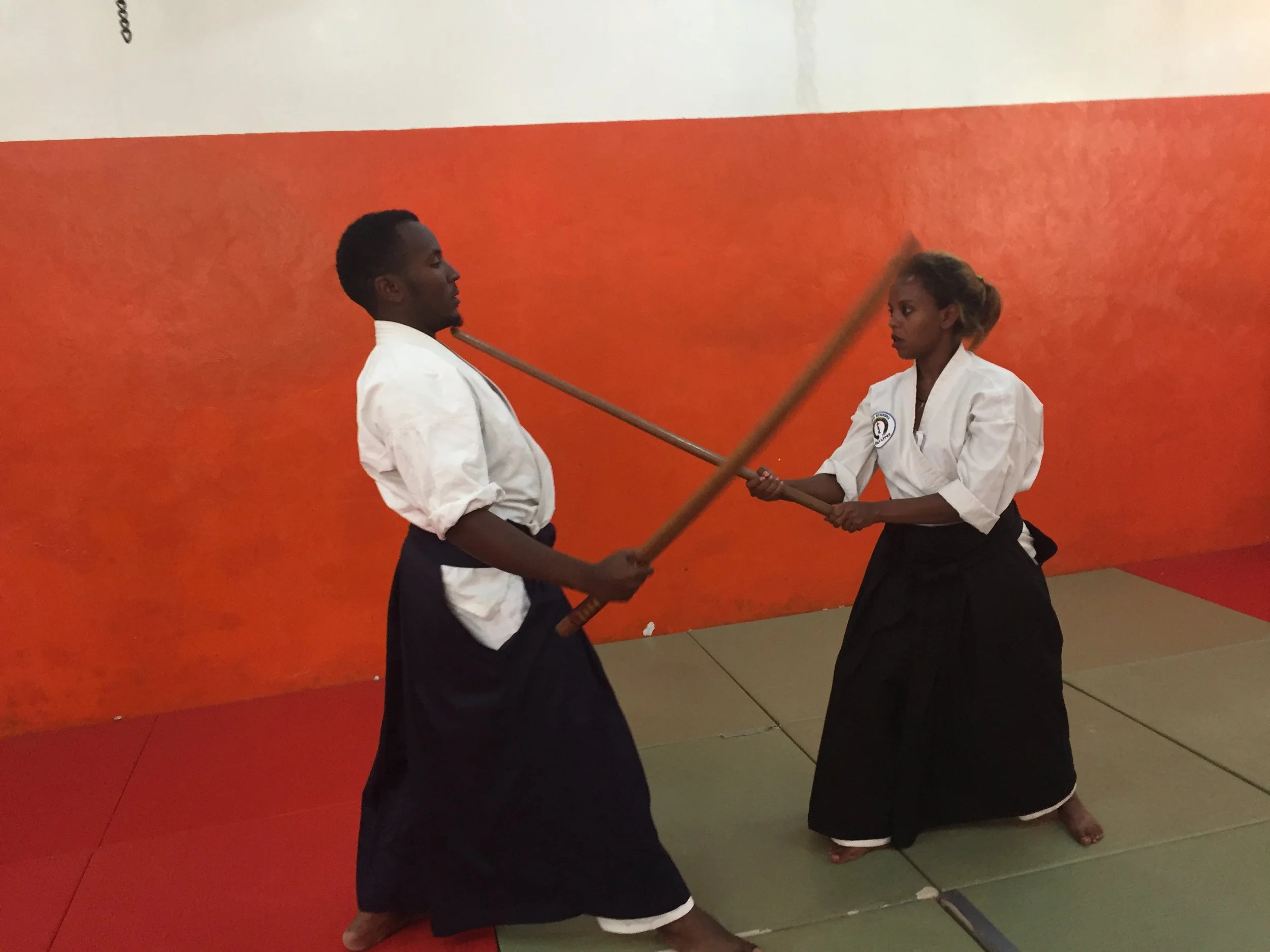
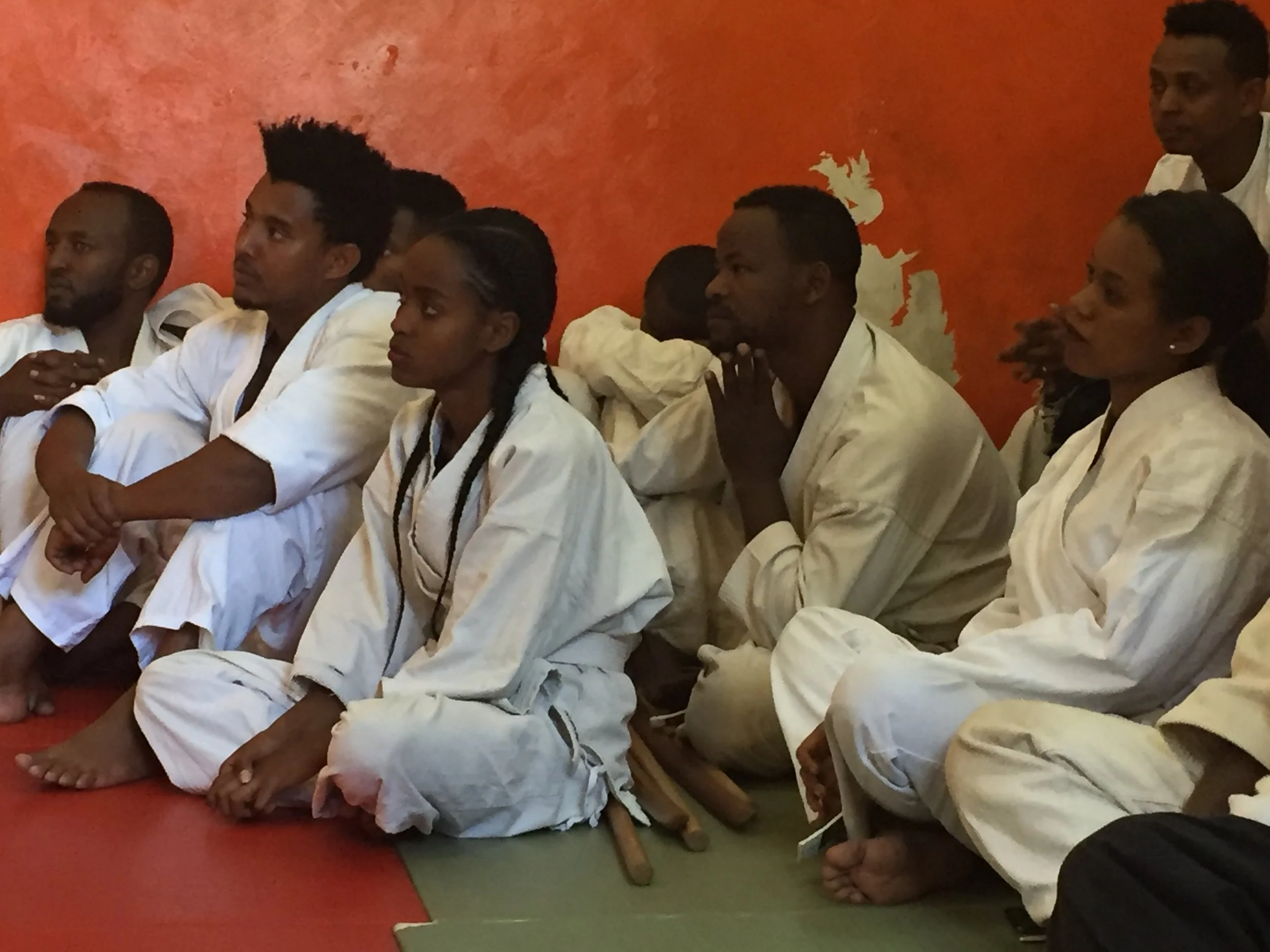
Report #4 from Abyssinia: Aikido at the U.S. Embassy Addis Ababa

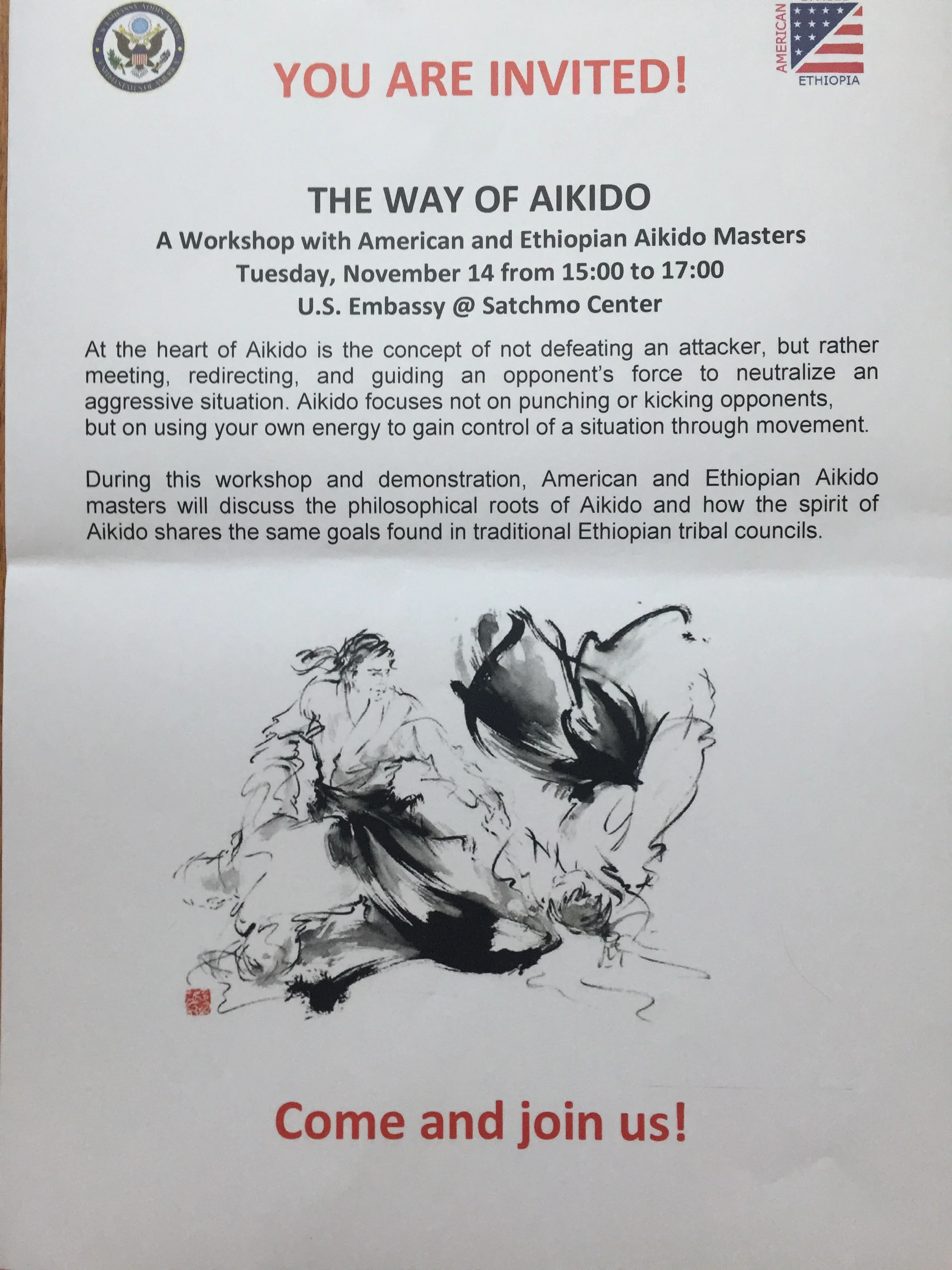
The U.S. Embassy in Addis Ababa sits on a slight rise with an expansive view of the northeast section of the city and beyond to the distant Intoto hills and mountain range. We’re above the haze and traffic and I can taste the sweetness of the 8,000 feet air. This is an upscale part of the capital with wide streets, flowering jacaranda trees, and well-kept gardens. This is the fourth largest American embassy in the world and the largest in Africa and it sparkles with watered lawns, immaculate rose gardens, and a fresh polish of seriousness and pride. Compared to where we’ve been it’s eerily quiet, an anticipatory charge in the air that’s as ordered and fitting as the neighborhood itself. I imagine it’s the hum from the listening devices and cameras coming from the embassy. I’m not sure if it makes me feel more secure or more threatened. In Aikido we practice both an internalized security through cultivating our attention, focus, and presence, and the ability to center in even the most chaotic circumstances. We externalize safety by embodying martial skills for defending our selves, and defending those who can’t defend themselves. And through a depth of practice we learn that there is no other, there is no enemy, our perception of duality is an illusion. But being processed through the elaborate security checkpoint of the embassy is a real time challenge of living into this idea that Oneness is more than philosophical candy. However, the promise of an awakened state in which we live in a non-dual reality has long been the tradition of the warrior archetype. Yes it is a life long practice and one that is needed in these times more than ever; and bridges aren’t made of air, we know that this means taking on practices that bring this vision to life.
In the last year Tes and Lou have met with various staff at the embassy educating them about our project of cultural exchange and to ask if they would like to partner in the East African Aikido Seminar and the forming of the East African Aikido Association. After a number of contacts the cultural attaché Li Ping Lo stepped forward with a genuine curiosity in the art and how it’s grown in Ethiopia and beyond. She suggested we do a lecture and demonstration for the ambassadorial staff and the Marine security detachment. So here we are: Demelesch, Rudy, and Tariku-our newly minted Ethiopian nidans- and Tes, Katina, Lou, Grayson James, a senior student and teacher at Two Rock Aikido, and myself are shown into the library where we all immediately notice that there is only a thin rug on top of concrete. While some of us chat with the staff the others drag a throw rug to put on top of the existing rug, but it falls woefully short of anything resembling a mat that one can easily fall on. The look that passes between us says, “OK, we make the blend”. We also know it will be best, actually mandatory, to smooth out the angles that exist in our falls so no one limps home.
Yvon, the director of embassy security, welcomes us and tells us that at one point he studied jiujitsu and had even tried aikido. I welcome him to the seminar and he gracefully bows out but promises to come if he can clear his schedule. I hand him a copy of The Leadership Dojo and he looks carefully at the title and then innocently says, “I’ve read some books by him” and then looks up startled, “That’s you!” and we all get a good laugh at the “shrinking world” and have a robust conversation ranging from martial techniques to walking a path of awakening.
The ambassadorial staff, the Gunnery Sergeant and five Marines from the Marine Security Detachment, the deputy ambassador, and Yvon, take their seats. I begin with introducing a brief history of Aikido and how Tes and I became connected through the Training Across Borders Seminar in Cyprus in 2005 and how he eventually came to live and train with me as uchi deshi (live-in student) at the Two Rock Dojo in California. Tes, with a prepared slide show and video, tells the history of Aikido in Ethiopia. Then the slide show breaks down. With all the marvels of technology assumed to be present at the largest U.S. Embassy in Africa, the seeming disregard for well-made plans in Ethiopia instantly dismisses us. The marvel of uncertainty, the alarming fluidity of Ethiopians to adapt to uncertainty amazes. Tes nods to the breakdown but doesn’t miss a beat as he continues and then moves into the demonstration itself. The audience heaves to life as bodies are suddenly flying through the air, thrown about, pinned to the floor, smile as they energetically jump to their feet to return the favor, nod in appreciation when a particular good move is executed. I’m reminded of what a beautiful art it is, as if I am seeing it for the first time through their eyes, as I did forty-five years ago in a quonset hut in the jungles of Kauai.
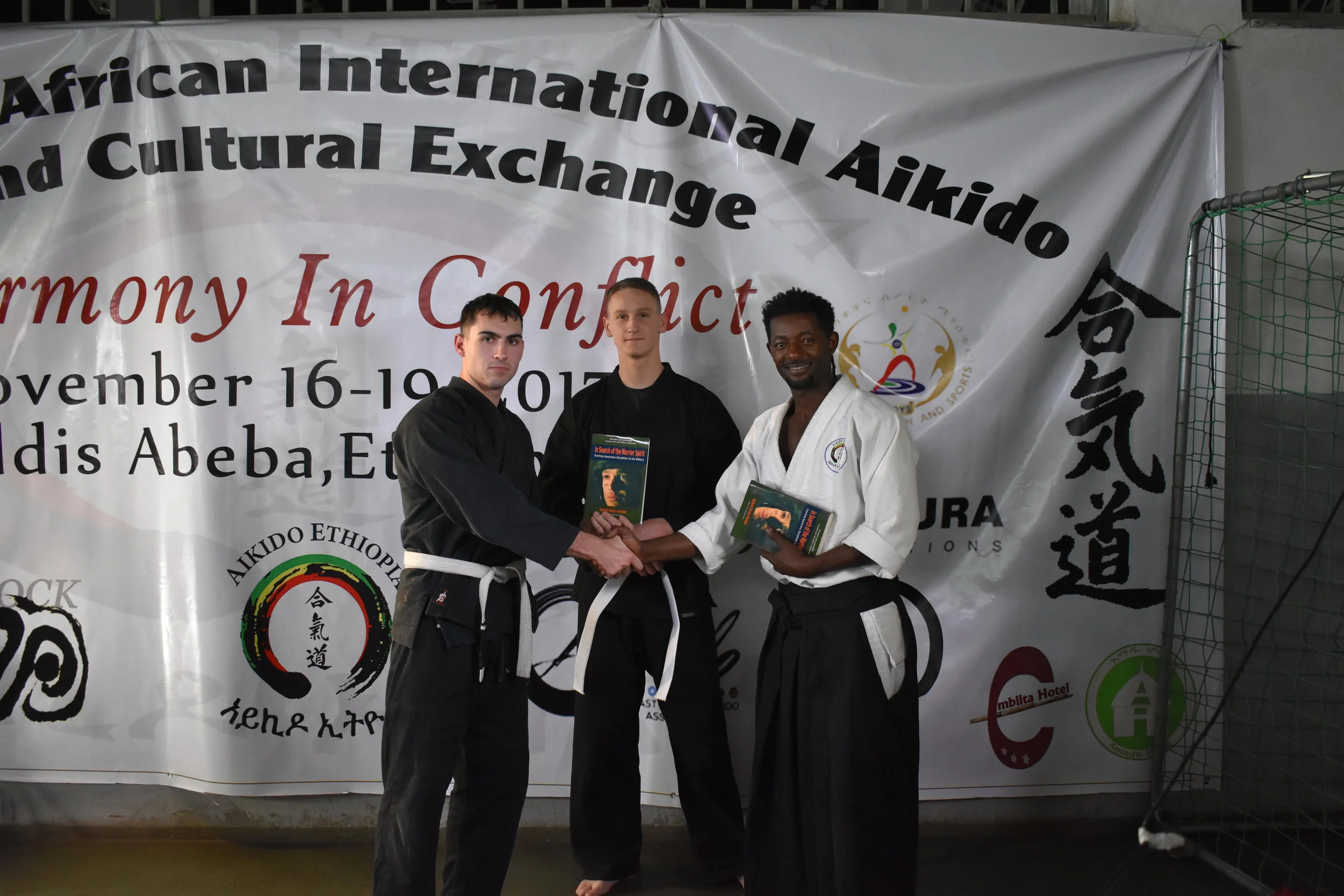
We complete with a question answer period in which the embassy staff suddenly comes alive with questions as do the stern faced Marines as they inquire into what they were seeing. One of the Marines qualified as an instructor in the Marine Corps Martial Art Program (MCMAP) and another one has his brown belt and they’re keen to show what they know so we’re on our feet with them trading techniques and counters and feeling for openings and having fun. They’re intrigued that I helped design and implement MCMAP in 2001 and I’m folded in by the mystery that it’s in Ethiopia that some circle is completed as I tell them how it began as a vision from the Commandant General Jim Jones.
At the end of the demonstration, the deputy ambassador in attendance inquires about the possibility of one or more of the senior students from Aikido Ethiopia begin to offer classes at the Embassy. In addition, two of the Marine guards subsequently attend two days of training during the Aikido seminar; and Rudy, the 22 year old Nidan demonstrating, and first black Africa woman to receive a Dan ranking in sub-Sahara Africa, will present an Aikido demonstration and lecture during the U.S. Embassy's annual Action Against Gender-Based Violence.
We walk to our car in the bright sunlight happy and tired. I look over at Tes and he has a big smile on his face.
Report #3 from Abyssinia: 900 grams
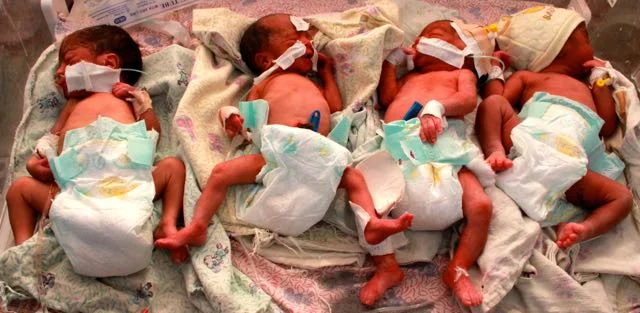
St Paul Hospital Millennium Medical College is on a sun baked west facing hill footed by rusted corrugated iron and canvas shops, and a relentless roar of foot traffic, buses, cars, and small van transports. It’s a large, rectangular, multi-storied building that’s a beehive of patients and medical staff swarming in and out of the front entrance. The building is like a worn spinster sitting sedately in a seething mass of humanity. Today a bank of white clouds pause above the hospital, as if on the threshold of this world, deciding to come in invited, or not.
Lou Pollack is a new born intensive care physician who has volunteered here for the past three years and three years before at Black Lion hospital teaching the fundamentals and recent research in how to save a premature baby’s life. Before the Aikido seminar begins I ask him to show me his work at the hospital and he asked me if I would speak to the provost about the issues the teaching hospital are facing. On the third floor we walk through a maze of people sitting in chairs, asleep on the floor, lying on gurneys, running, or simply standing as in a daze. I glance into open rooms where up to six women are giving birth, recuperating from birth, or dying. Lou outfits me with a green staff gown and escorts me into a room with nine incubators, four overhead radiant warmers often with two babies to an incubator attached to tubes, wires, and monitors to keep them alive. Most of them weigh no more than 900 grams and their legs are no thicker than my finger. An iron grip has suddenly tightened my throat, my breath rises and is caught around my heart, a protective layer encasing me, there’s an upwelling in my eyes. These small wonder plants seeking fertile ground and proper cultivation to grow past these machines that sustain their life. Some seem to be asleep others look deeply into my soul, unblinking even in the violence, blood, and tissue of birth, into some unknown beyond. This is a place of hope and sorrow.
“Sit here” Lou says, pointing to a large padded chair, “and see what you can. It could be useful to me to see what you see.” My first impression is that it’s a non-stop rondori(rondori is a Japanese term used in the Aikido that roughly translates “chaotic movement”. At the completion of every black belt test there is a multiple person attack that the candidate must handle in order to pass). The room is hot and crowded with physicians, residents, nurses, staff and the occasional mother performing their assigned tasks. Their scrubs and uniforms are sweat stained. Everyone is shoulder to shoulder crowding around the incubators. The next image that emerges are field hospitals in combat zones. That is, humans using their skills to save lives and minimize pain and suffering; a magnitude of the heroic in these circumstances as well with so few resources but with an abundance of will and commitment. And in both cases, it is pure transaction; feelings and emotions closeted away somewhere safe from the sorrow and hope residing here. Tears run down my cheeks. I hold my body still; is it from all that is not expressed in this room living through me; or is it years of my grief that has not been allowed to come to life; my 900 grams striving for legs to stand on and arms to reach towards love, and to be loved.
Lou takes me to the office of Dr. Wendmagegn Gezahegn, the Provost of the Medical College. From his desk piled with stacks of papers, folders and journals he pulls out a copy of The Leadership Dojo and he tells me of the dilemmas of the hospital and how these are leadership issues. He calls in a woman who heads their innovative and educational programs. We have a lively conversation about bringing a leadership program to the hospital. It is a surprise ending to the hospital visit and holds the promise of something that Tes and I have long spoken about: bringing SI embodied leadership programs to Ethiopia. Lou and I are jaw dropping surprised and happy and we high five each other. As I tell this to Tes when he picks me up I know that a condition of success for a program will be to double, or triple, that 900 grams for those wonder plants reaching for life.


Report #2 from Abyssinia: We Have the Stamp!
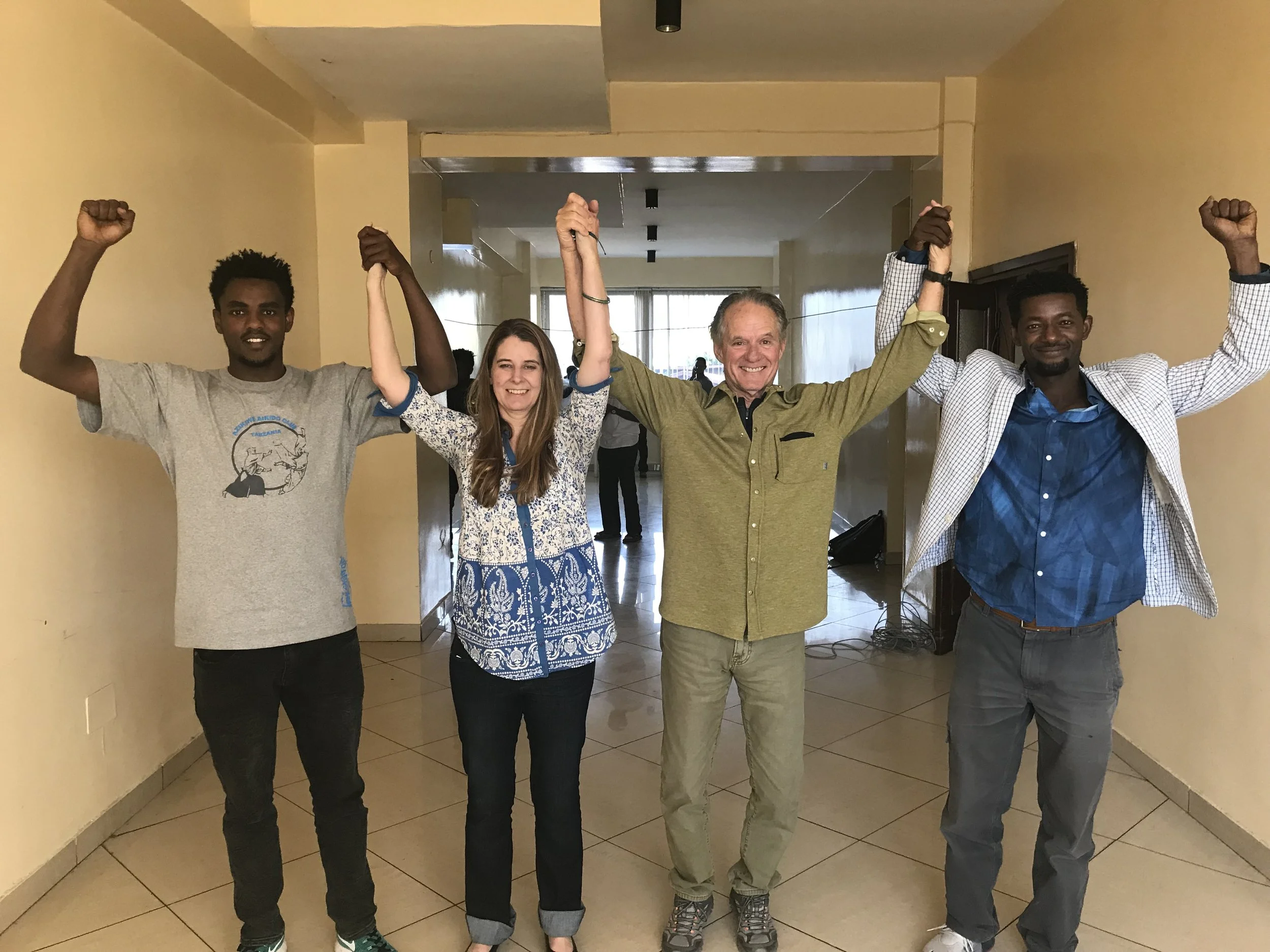
Monday is recover from jet lag day so myself, Tom Lutes, and Katina Bishop tag along with Tes and Demelash to the offices of the Ministry of Youth and Sports. For over two years Tes and Demelash have been doing the bureaucratic and diplomatic legwork to receive the stamp of registration for Aikido to be recognized by the state. To receive this certification we can then go to any one of the ten regions of the country and have official sanction which means possible financial support and access to sites for dojos to train in. Even though we have already established Dojos in these areas, to have the stamp of registration makes us official with the Ministry of Youth and Sport, and that has the potential of opening new possibilities. Demelash has been shepherding this through from Addis Ababa and this visit is held as a routine event, but perhaps my presence, as a ranking Aikidoka, might had some fuel to the process.
The staff in the Ministry greet Tes and Demelash as old friends as we’re guided into the Minister’s crowded offices on the third floor. Hadush, the advisor to the Minister appears out of an inner door and graciously sits us and excitedly explains all the research he’s been doing on Aikido on YouTube, Wikipedia, the Internet, and other places that I don’t quite understand. He asks us to wait a moment and ducks back into the inner office and then returns almost immediately holding a sheaf of papers telling Tes and Demelash with great animation that thanks to him the Minister has vetted the process and he is now drawing up the papers that will provide the stamp of legitimacy. He repeats the story countless times as he stands over the secretary as she types up the papers, continues the same story in the Minister’s office, and with us in his office. We’re a bit suspicious that this may only be another story with no real action and at the same time containing ourselves from doing the happy dance and shouting out “We’ve done it!” As the papers are prepared Hadush says he’s very impressed with Aikido and will join the Dojo in Addis Ababa. Good sign.
The secretary types, Hadush moves from office to office, and three men confer at another desk. We wait. The secretary types, Hadush walks around with papers patting the air in front of us telling us it will be soon. We wait some more. We hope, but the temperature is dropping. He comes out of the inner room excitedly pointing to a formal stamp on the papers. “Look” he shouts, “the stamp! Look right here, the stamp.” Pointing his finger at a stamp with the Minister’s initials through it. “The stamp!” he repeats victoriously. Yes the stamp. We are smiling widely at each other. We’re thanking him and hugging him and sharing high fives and fist bumps.
We’re on the street doing the happy dance to the curiosity of by standers. “The stamp. We have the stamp!” we laugh. May the stamp do good in the world.
Take it easy but take it!
~Richard

Report #1 From Abyssinia!
As we descend into the high plateau of Addis Abba the lights below speckle the African night like flakes of orange rind, bone shards, the occasional watery blue. Twelve hours ago I was standing in front of six hundred people giving the keynote address at the 4th Annual Mindfulness and Leadership Conference in Washington D.C. Now I’m landing in the Horn of Africa to help convene the first East African Aikido Seminar and launch the East African Aikido Association. The marvel of it! The reach that is available to us, psychic and geographical, to be in awareness practices with so many people in so many places so that we can cultivate grounded compassion, pragmatic wisdom, skillful action, and use conflict as a generative force.
Strozzi Institute and Two Rock Aikido Dojo in partnership with the Ethiopian Ministry of Sport, the African Union, and the assistance of the American Embassy have been planning this seminar for over a year. Tesafye Tekelu, Lou Pollock, Katina Bishop and myself have been on the coordinating committee and now on the ground here in Addis Ababa we know the dream is coming to fruition.
We are busy putting everything together for a visit for the participants from Ethiopia, Somalia, Djbouti, Tanzania, Uganda, and Kenya- 150 in total. In addition we will have a cultural exchange with the elders from the prominent tribes here in Ethiopia.
Take it Easy But Take it
Richard
Aikido: A Martial Art with Mindfulness, Somatic, Relational and Spiritual Benefits for Veterans
Aikido: A Martial Art with Mindfulness, Somatic, Relational and Spiritual Benefits
for Veterans
David Lukoff, PhD
Sofia University
Palo Alto CA
Richard Strozzi-Heckler, PhD
Strozzi Institute
Oakland CA
This manuscript is in press for Spirituality in Clinical Practice © 2017, American Psychological Association. This paper is not the copy of record and may not exactly replicate the final, authoritative version of the article. Please do not copy or cite without authors permission. The final article will be available, upon publication, via its DOI: 10.1037/scp0000134
Abstract
Aikido is a martial art which originated in Japan and incorporates meditation and breathing techniques from Zen Buddhism. Like all martial arts, it requires mindful concentration and physical exertion. In addition, it is a compassion practice that also provides a spiritual perspective and includes social touch. These components make Aikido a unique form of mindfulness that has the potential to be particularly appealing to veterans coming from a Warrior Ethos tradition who are used to rigorous somatic training. Mindfulness practices have shown efficacy with veterans, and the self-compassion, spiritual, and social touch dimensions of Aikido also offer benefits for this population, many of whom are struggling with these issues. Several pilot Aikido programs with veterans that show promise are described.
Aikido, like all martial arts, requires mindful concentration and physical exertion. In addition, it is a compassion practice that provides a spiritual perspective and social human touch. Aikido emerged in 20th century Japan following an evolution of martial arts over hundreds of years from a system of fighting arts (bugei) designed to inflict injury and death, into a Way (in the Eastern sense of Tao or “do”-- path of self-development). Aikido translates as the path (do) to a union (ai) with life-energy (ki). The founder of Aikido, Morihei Ueshiba (1964), who was considered a “national treasure” for his martial arts mastery, had a spiritual awakening in which he realized,
The Way of the Warrior has been misunderstood. It is not a means to kill and destroy others. Those who seek to compete and better one another are making a terrible mistake. To smash, injure, or destroy is the worst thing a human being can do. The real Way of a Warrior is to prevent such slaughter – it is the Art of Peace, the power of love. (Hyodo, 2010, p. 76)
Ueshiba highlighted the self-development and spiritual dimensions in his martial art, and described it as “The Way of Harmony.”
Aikido emphasizes working with a partner, rather than sparring, grappling or fighting against an opponent in competitive tournaments. Aikido techniques neutralize and control attackers instead of violently defeating them. Blending movements are used with breathing practices to somatically create harmony in conflictual encounters (Shioda, 1991). It has often been described as a moving meditation because it involves concentrating purposefully on each technique element, being aware of others, maintaining balance, controlling breathing, and connecting with the training partner. These actions establish a psychophysiological state of relaxed attention in which one responds quickly, precisely, and courageously to physical attacks, including those by multiple attackers (Lothes, Hakan & Mochrie, 2015).
The authors have decades of experience utilizing Aikido with veterans and active military. We believe that Aikido has unique appeal and benefits for these populations because it is a martial art that is also a mindfulness practice, somatic exercise, compassion practice, and spiritual path while also providing opportunities for social touch. Veterans are at high risk for committing suicide with an average of 20 veterans a day dying from suicide in 2014 (Currier, Kuhlman, & Smith, 2015). PTSD is the most common psychological condition diagnosed among military personnel and contributes to a wide range of other adverse health outcomes including panic attacks, depression, substance abuse, sleep disturbance, family dysfunction, and occupational impairment (Currier, Kuhlman, & Smith, 2015). Aikido is discussed here as a practice that has the potential to be particularly beneficial for veterans struggling with these problems.
I. Mindfulness Practice
Historically, meditation and related breathing exercises have been a part of Japanese martial art traditions since the days of the Samurai in medieval Japan where warriors who dealt with life and death everyday embraced the meditation practices of Zen monks to help them calm their mind and body (Lothes, Hakan, & Kassab, 2013; Stevens, 1992, 2002). Like tai chi, Aikido is often described as moving meditation or mindfulness in motion that requires stilling of the mind while the body is in motion. The training process has many parallels with meditation training. An Aikido student trying to learn an unfamiliar technique is likely to have distracting thoughts, such as “which foot goes where? or “I’m not doing it right.” This is similar to the novice meditator who finds it difficult to stay focused on their breath or mantra. But over time, with practice, both the meditator and the Aikido practitioner improve their ability to recognize a distracting thought and come back to the present.
With continued training, Aikido students learn ways to defend themselves from not only physical attacks, but from verbal and emotional attacks as well. For this reason, Aikido practices have been incorporated into non martial arts mindfulness programs such as Jon Kabat-Zinn’s well-researched and widely disseminated Mindfulness Based Stress Reduction program (MBSR; Kabat-Zinn et al., 1992). For example, in one exercise developed by George Leonard (1999), an Aikido sensei (teacher), MBSR students break up into pairs in order to,
help us to act out with our bodies, in partnership with another person, the experience of responding instead of reacting in threatening and stressful situations…In class, the partner who is “attacking” always represents a situation or person who is “running you over,” in other words, causing you stress. After trying reactions such as pushing to fight back (fight), running away (flight) and cowering (freezing), the MBSR training requires what is called blending in aikido…It requires that we be aware of the other person as a stressor without losing our own balance of mind. (Clark, 2017, M.B.S.R. Course: Aikido)
Remaining calm and balanced amidst conflict is a mindfulness skill that is not an automatic response, but can be learned through practices that involves rigorous training in an alternative response to the ‘fight or flight’ reaction. This method of dealing with conflict from a relaxed grounded stance becomes a new learned coping response to stress in all forms of conflict, not just physical (Heckler, 1985; Strozzi-Heckler, 1993).
While research documenting that training in Aikido enhances mindfulness is more limited than for sitting meditation techniques, there are a few studies that establish this connection. Lothes et al. (2013) investigated 159 participants using two empirically validated scales of mindfulness and awareness: the Kentucky Inventory of Mindfulness Skills (KIMS) and the Mindfulness Attention Awareness Scale (MAAS). Their survey asked participants their Aikido rank, which roughly corresponds to the number of years of regularly attending Aikido classes. A comparison group of non Aikido practitioners who were not engaged in any mindfulness practices was also assessed. The Pre Black Belt group with 3-44 months of training scored significantly higher than the Control group on both measures, and the Black Belt group with 66-348 months of training scored significantly higher than both the Control group and the Pre Black Belt group.
Longitudinal research by the same authors studied 12 Aikido students with no prior martial arts experience from their beginning through their first belt ranking tests (approximately 9 months of training). A control group of participants was recruited from a psychology class. A one-way repeated measures ANOVA showed a significant effect of Aikido training on the KIMS (p < .0001) and also on the MAAS (p < .01). Post hoc t tests run between Aikido and Control groups on the KIMS and MAAS scores at each testing time showed statistically significant differences between the Control and Aikido groups that were not present at baseline.
Lothes et al., (2015) conducted a second longitudinal study with five Aikido students from the start of training through to their obtaining their black belts (a minimum of five years of training) at the University of North Carolina Wilmington Aikido Club. The KIMS and MAAS were administered to these participants at 9 month intervals during their training. One-way repeated measures ANOVAs showed a significant effect of Aikido experience on the KIMS between start and black belt (p <. 0334) and also on the MAAS between start and black belt (p <.05). This longitudinal study documents the long-term effects of Aikido training on mindfulness, and the results from these three studies suggest that Aikido significantly enhances mindfulness. Tai chi, also considered a martial art and moving mindfulness practice (with some traditions emphasizing health benefits over martial prowess), has also demonstrated a positive impact on mindfulness in studies (Wayne, 2013).
Prior research has already established that, “Mindfulness-based modalities have shown particular promise in veteran populations dealing with PTSD” (Kopacz & Connery, 2015 p. 64). One vivid example is Rudy Reyes (2009), a Recon Marine who has written a book and been featured in HBO’s Generation Kill and the History Channel’s Apocalypse Man. In these media he describes how the psychological and spiritual damage he suffered from tours of duty in Iraq and Afghanistan were repaired by the practice of Asian martial arts disciplines.
II. A Somatic Practice
Martial arts training typically requires constant bodily movement throughout a 60-90 minute class. While no study has demonstrated the effects of Aikido on aerobic capacity, studies with other martial arts have shown that practitioners have better aerobic capacity, balance, strength, body fat percentages, and flexibility compared to sedentary controls (Douris, and Chinan, 2004). One review of the research concluded:
Martial arts are an increasingly common and important form of exercise for many individuals. While any form of exercise benefits physical well-being, martial arts may also improve the practitioner’s sense of psychological well-being. (Woodward, 2009, p. 42)
Tai chi practices involve movements that are similar to Aikido but are mostly done without a training partner. Tai chi has been shown to increase lung capacity (Jahnke, Larkey, Rogers, Etnier & Lin, 2010) as well as benefiting “participants by increasing flexibility, reducing symptoms of depression, decreasing anxiety, and improving interpersonal sensitivity...balance, run times, quality of sleep, symptoms of compulsion, somatization and phobia, and decreased hostility” (Webster et al., 2016, p. 103; also Solloway et al., 2016).
The research demonstrating that somatic exercise has benefits for the brain and body is compelling, including reductions in depression, enhanced well-being, and improved memory and cognitive processing. Somatic exercise has been used as a form of behavioral activation in treatment of depression to increase engagement in activities that improve mood (Mazzucchelli, Kane, & Rees, 2010). Exercise triggers the release of serotonin, norepinephrine, endorphins, and dopamine that improve mood, reduce pain, and relieve stress. Exercise has also been found to facilitate neurogenesis including creating stronger connections between brain regions, reducing age-related brain atrophy, increasing blood/nutrient flow to active regions, strengthening existing synapses, and building new synapses through the release of Brain-Derived Neurotrophic Factor (BDNF) (Ratey, 2013).
Meditative Movement has been proposed as a new category of somatic exercise with unique benefits (Larkey, Jahnke, Etnier, and Gonzalez, 2015). From a neuroscience perspective, Russell and Arcuri (2015) argue that,
By moving in a mindful way, there may be an additive effect of training as the two elements of the practice (mindfulness and movement) independently, and perhaps synergistically, engage common underlying systems (the default mode network)…[W]orking with mindful movement may be one route to mindfulness training for individuals who would struggle to sit still to complete the more commonly taught mindfulness practices. Drawing on our clinical experience working with individuals with severe and enduring mental health conditions…[mindful movement] can be used to help those who are suffering and for whom current treatments are still far from adequate. (p. 1)
John Ratey, MD is a Clinical Professor of Psychiatry at Harvard Medical School, and an internationally recognized expert in neuropsychiatry with over 60 peer-reviewed articles and 11 books focused on the brain-fitness connection. When he was asked during an interview which sports or activities were the most beneficial for the brain, his answer was martial arts:
I think the very, very complicated ones. One is tae kwon do or karate, jujitsu--using your movement while you're learning and focusing and training your movements and then interacting with another person. All that puts a great strain on the brain, which the brain actually loves. (“Exercise and the Mind”, 2001)
III. A Compassion Practice
Compassion is the emotional response of caring for and wanting to help those who are suffering (Goetz, Keltner, & Simon-Thomas, 2010). Recent studies have shown that compassion training improves personal well-being, reduces stress-related immune responses, and increases positive affect, psychological and somatic health, and prosocial behavior (Lutz, Brefczynski-Lewis, Johnstone, & Davidson, 2008). These studies utilized a Buddhist practice called metta (“lovingkindness”) in which compassion is cultivated towards different people, including loved ones, strangers, difficult persons, and ultimately all people (Salzberg, 1997). Compassion training always includes self-compassion which emphasizes kindness towards one’s self, a feeling of connectedness with others, and acceptance of distressing experiences (Neff, Kirkpatrick, & Rude (2007). Self-compassion can be a helpful self-care skill for coping with the guilt and shame that many veterans report as well as other symptoms of PTSD (Thompson & Waltz, 2008).
Developing compassion for others is inherent in the practice of Aikido (Frager, 1977). An oft cited quote from Ueshiba in dojos is, “To injure an opponent is to injure yourself. To control aggression without inflicting injury is the Art of Peace” (Stevens, 1992). This stance of extending compassion to all human beings inculcates the sincere desire to not harm others, including attackers despite their aggression, but to “reconcile where there is strife” (Westbrook & Ratti, 1970, p. 361). Aikido training enables a person to better control somatic and emotional reactions, thus allowing that person to behave in accordance with a philosophy of conflict resolution in situations that would otherwise trigger automatic behavioral reactions. An Aikidoist learns how to avoid confrontations or clashes with a challenger. Instead, he or she,
accepts, joins, and moves responsively with the flow of the challenger’s energy in the direction in which it is going. Such blending quells resistance, because the Aikidoist offers nothing for the challenger to resist. Hence…the Aikidoist can guide the challenger in more positive and constructive directions. (Saposnek, 1986-1987, p. 124)
Defensive skills and control techniques allow the Aikidoist to contain the attack so that neither he/she nor the attackers are harmed. In contrast, other martial arts include techniques designed to hurt an opponent. Aikido sensei also inform and remind students that the physical practices of Aikido teach how to cooperate with others outside of the dojo (Heckler, 1985; Westbrook & Ratti, 1970).
Another dimension of compassion in Aikido is that both partners need to take care of each other to ensure that the training is safe. Incorrect movement on the part of either partner may increase vulnerability to injury. Martial practices require attention to the well-being of one’s partners, which is the essence of compassion.
Conflict resolution techniques usually begin with first attempting to understand the other person’s point of view. Within the context of a social interaction, blending entails listening, accepting, acknowledging, and empathizing with the other person’s point of view while simultaneously maintaining one’s own point of view. Kroll (2013) and Levine (1994) have explicitly extended Aikido training to verbal arguments to show that there are more options available than dominating, obliging, or avoiding when conversing with others on contentious issues: “aikido affords a framework for understanding argument as harmonization rather than confrontation” (Kroll, 2008, p. 451). This “expands…options for engaging in verbal conflict” (Kroll, 2015, p. 221). Aikido sensei Mitsugi Satome described it this way, which applies to both physical and verbal attacks: “When someone grabs your wrist it does not mean the start of a fight; it is the beginning of a conversation” (Levine, 2015). Through the use of Aikido-based somatic practices with military and veterans, I (RS-H) have found that, “it’s possible to learn to make this kind of connection that creates deep listening to others, fosters genuine trust, encourages respect and dignity in the treatment of others and the negotiation of conflict in a way that results in a win-win for all involved” (Strozzi-Heckler, 2007, p. 421).
IV. A Spiritual Practice and Community
Spirituality is “the direct experience of one’s connection and unity with others and the world” (Sperry, 2016, p. 222). In contemporary society, at least a quarter (and increasing) number of people practice secular spirituality outside of established religious institutions and identify as “spiritual but not religious.” While America is a quite diverse country, for a majority of the population, their religious faith is still their main source of spirituality (Pew, 2015). Aikido can be considered a spiritual practice, but it is not a religion. To train in Aikido does not require adherence to any person or dogma. It has no cosmology or specific political, economic, social agenda other than harmonizing conflict to create peace. Aikido has no specific prescription or requirements for how one must live one’s life (e.g., The Ten Commandments). The core of its spiritual beliefs focus on creating or restoring peace and harmony in human relationships, including within oneself.
Aikido has been influenced strongly by Shintoism, Confucianism, and Buddhism (Stevens, 1992, 2001). It is practiced in a dojo, a word with Buddhist origins meaning “Place of Awakening.” Contemporary Aikido has preserved this spiritual heritage by fostering an acceptance of death and conflict without fear and attending to the present without distraction. Yet historian Taylor (1977), founder of the Harvard Aikido Club, has argued that Aikido has evolved in America from its Japanese roots to shift the emphasis from,
a martial art to a spiritual discipline…The context in which it is taught is neither Japanese nor for purposes of martial combat…but for personal growth appropriate to the changing textures of American consciousness…[This has led to] the development of a fluid style that is uniquely contemporary and American in character. (p.12)
In her ethnographic study of an Aikido dojo, Rothman (2000) found that the intimate somatic contact that occurs during training, combined with the spiritual goal of creating harmony in the universe and in one’s self, produced bonds among the Aikidoists. A phenomenological interview study with Aikido practitioners concluded that Aikido is a transformational practice that: a) results in a perceptual shift toward seeing oneself and the world as interconnected flows of energy; and b) gives rise to the ability to extend love to others (Olliges, 2008). Practitioners often describe this flow of energy as ki and report developing an experiential embodied understanding of harmony, energy and spirituality (Palmer, 2002).
In the U.S. Army’s Comprehensive Soldier Fitness (CSF) program, spiritual fitness is considered a source of resilience for:
being able to accept the reality of a situation, develop creative coping strategies, find meaning in trauma, maintain an optimistic view of the future, access their social support network, generate the motivation to persevere, grow from adversity, and mitigate serious psychological problems such as posttraumatic stress disorder. (Pargament & Sweeney, 2011, p. 59).
Like most religions and spiritual practices, Aikido fosters learned optimism toward the world (Sethi and Seligman, 1993), and resilience (Faggianelli and Lukoff, 2006), both core aspects of spiritual fitness.
It is well-documented that many veterans have spiritual struggles related to moral injury and other aspects of their military life. Research has shown that spiritual fitness is a coping resource that improves outcomes from these struggles (Kopacz & Connery, 2015). Aikido may be particularly helpful for some veterans who are experiencing spiritual struggles where their “old meanings fail to provide comfort and solace, [and] they are left to look for new explanations, values, and beliefs” (Kopacz & Connery, 2015, p. 62; Lukoff, Lu, & Turner, 1992).
In addition, a protective factor identified in suicide prevention “is participation in personally meaningful activities, typically within a social context that brings the individual into contact with various resources and source of social support” (Bryan, Graham, & Roberge, 2015, p. 75). The multiple psychological and somatic health benefits of church membership are well-documented and could apply to being a member of an Aikido dojo, including lower likelihood of suicidal ideation, attempts, and deaths for which veterans are at high risk (Currier, Kuhlman, & Smith, 2015; Vieten, Scammell, Pierce, Pilato, Ammondson, Pargament, & Lukoff, 2016). Martial arts training programs that incorporate the core values of Aikido to develop spiritual fitness have been successfully implemented by the author (RS-H) with Special Forces and in the Marine Corps Martial Arts Program (MCMAP) (Strozzi-Heckler, 2007). Within the Marine Corps, “where units are training regularly [in MCMAP], there is a significant reduction in alcohol and drug abuse, domestic violence, police incidents…unauthorized absences, lateness, fighting, and poor morale” (Strozzi-Heckler, 2007, p. 367). Aikido dojos offer the structure and environment for developing spiritual fitness by fulfilling basic needs for coping skills, relational connection, meaning, and social support within a spiritual context.
V. Social Touch
While there is a weapons component in Aikido, most techniques are executed using hands. Open handed combat was taught to samurai for situations when they could not use their sword, spear, or bow and arrow, such as if they became disarmed in battle or were in a place where carrying weapons was forbidden. In contemporary Aikido practice, hands are used to connect with a partner rather than to punch or strike them. As one Aikido sensei describes it:
In Aikido, as opposed to some other martial arts, the skin is being touched. It is not being hit, kicked or punched. There is contact, skin to skin. And for many people, this is the first time they are being touched by another human being that day. It changes the flow of the internal and external conversation we have with ourselves, and with others. We need to include another person now…Aikido involves an almost joyful willingness to be touched, to want to touch. (Rest, 2015, p.72-3)
Another sensei also views touch as foundational to Aikido:
It's really a quality of touch that you're trying to learn. In general, your hands must be soft and yielding. Keep your hands very relaxed and heavy. You never want to grab or clutch. This cuts off your ki and makes it impossible to feel where your partner is going. A light, soft, relaxed touch is all that is necessary. (Bornstein, 1998)
Aikido includes frequent skin-to-skin contact and many techniques require that bodies be positioned next to each other, and that hands touch necks and arms, and sometimes faces. In the dojo, students consent to being touched. Some who are uncomfortable with this kind of intimate touch discontinue their training.
Touch has important benefits for humans as primates. Grooming among many primate groups occupies 20% of time spent together, much more than is necessary for hygienic needs such as removing lice (Dunbar, 2010). American society has strong taboos against intimate touch, and many consider America to be a touch-deprived culture. Studies have shown that people in the USA touch each other much less than people in many other cultures. For example, American, French and Puerto Rican friends were observed in a coffee shop to determine how frequently physical contact occurred. American friends touched each other an average of only twice an hour, whereas French friends touched 110 times, and Puerto Rican friends touched 180 times (Field, 2014). Yet touch has a positive effect on growth, brain waves, breathing, and heart rate, and decreases stress and anxiety (Derlega, Cantanzaro, & Lewis, 2001). Lack of touch is associated with depression, eating disorders, aggression, and self-injurious behaviors (Field, 2014).
Touch is our most social sense. Seeing, hearing, smelling, and tasting can generally be done alone. Some neuroscientists even consider the skin a "social organ" (Morrison, Löken, & Håkan, 2010). All primates, from monkeys to homo sapiens, rely on social touch. Among nonhuman primates, grooming is used to garner favors, earn social standing, increase access to resources. It is also a form of nonverbal communication that signifies a bonding gesture (Heslin and Alper, 1983). Humans are endowed with a second nerve network in the skin consisting of slow-conducting tactile C fibers that sense affection and tenderness. This network responds only to a gentle touch and activates areas of the brain involved in emotions. In addition, the human hand possesses a particularly refined sense of touch that can detect a raised spot just three microns high (a human hair has a diameter of 50 to 100 microns). This remarkable sensitivity is attributable to about 2000 touch receptors in each individual fingertip (Flanagan, Randall, & Lederman, 2001). The soothing power of touch is attributed to the release of oxytocin and endorphins and decrease in cortisol when being touched (Field, 2014).
While emphasizing touch may at first seem out of bounds within military healthcare, touch has been recognized through the development and rollout of the US Army Nursing Corps “Patient Caring-Touch System, a system that has allowed us to closely listen to the voices of our patients and our staff” (Gordon, 2012, p. 1). Many veterans report that they miss the camaraderie and intimacy they had with their military buddies. In addition many have problems controlling arousal when feeling threatened which interferes with giving or receiving social touch. Practicing social touching and also receiving caring touch constitute additional potential benefits of Aikido practice for veterans.
Aikido with Veterans
The VA has an active adaptive sports program whose goal is to help veterans transition from the VA into society by using adaptive sports to help them adjust. They have been supporting Tai Chi, Qigong, Taekwondo, and Judo, and this year Aikido was added to the VA Adaptive Sports Program in the Denver region. The benefits of Aikido as summarized in this article are echoed in this text from the homepage of the VA Adaptive Sports program:
Disabled Veterans of all ages and abilities report better health, new friendships and a better quality of life when participating in adaptive sports. Disabled Veterans who are physically active simply have more fun!
(https://www.va.gov/adaptivesports/)
Several projects are bringing Aikido training to veterans. Aikido for Veterans & Families is a nonprofit organization in Colorado that recently applied to the VA Adaptive Sports Grant Program for funding. For the past several years, free training has been offered to veterans and their family members at a dojo in Colorado Springs just outside Fort Carson. They are working with the Denver VA Department of Recreation Therapy. David Drake, co-founder of the program, reports that, "Veterans participating over a period of just a few sessions have reported feeling calmer, more capable of adjusting to situations outside their control, and are experiencing a greater feeling of well being than before they began practicing Aikido" (Aikido for veterans & families, D. Drake, personal communication, January 18, 2017).
Aikido for Veterans & Families has reached out to women veterans, many of whom have experienced military sexual trauma. “Studies conducted by the Government Accountability Office in 2007 indicated that 25% to 50% of all military women experienced some type of sexual harassment, and 20% experienced overt sexual assault during military service” (Van Pelt, 2011, p.8). Aikido for Veterans & Families has established research partnerships to launch a controlled study of outcomes among women veterans associated with this training.
In another program at the Cincinnati VA, psychologist Tobias Weiss observed that during therapy,
I was drawing more and more on my experiences with Aikido to explain the nature of conflict…that the philosophy of Aikido is the perfect augment to challenging irrational beliefs and finding stuck points keeping veterans from trauma recovery…Aikido would offer a physical way of reinforcing the messages of therapy for those who learn more by doing. (Weiss, 2008)
In coordination with Aikido of Cincinnati, he was able to secure mats and instructors. The VA chaplain granted permission to spread mats and create a temporary dojo every Monday night in the chapel on the residential unit. The instructors met with many challenges during the classes including recognizing and addressing the ways that Aikido might trigger re-experiencing of trauma, working with the medical limitations of the veterans, and addressing the deeply ingrained tendencies of individuals with PTSD to avoid conflict at all cost. The feedback from the veterans was overwhelmingly positive: “It improved my sense of well-being.” “It improved concentration.” “I never expected to come in for PTSD treatment and find myself in an Aikido class, but it tied in great with the message of finding a way of becoming unstuck in my recovery" (Weiss, Chard, and Shumm, 2011).
Due to the positive responses, Weiss organized an ongoing Aikido program in both the men's and women's residential units. They also conducted a study of 39 women diagnosed with PTSD who participated in a supplemental Aikido group in addition to the standard 7 week residential Cognitive Processing Therapy (CPT). Their outcomes were compared to a group of 61 women who participated in the CPT program without the Aikido component. There were no pretreatment differences on any of the measures, but at post test, the Aikido group showed a significantly greater decrease in self-reported symptoms of PTSD as measured by the Posttraumatic Stress Disorder Checklist (p < .045), and in depression as measured by the Beck Depression Inventory II (p = .007) (Weiss, Chard, and Shumm, 2011).
Portsmouth Aikido in New Hampshire offers free Aikido classes for Veterans, Uniformed Services Personnel, and First Responders. The program was triggered by the activism and book of veteran sensei Tom Osborn who spent decades of his life bringing Aikido to veterans. For many veterans, service is still an important value from their warrior training. Tom Osborn (2012) embodied this value in his book and numerous training workshops around the USA on Aikido with Veterans. He pointed out that, “It would be nice to contribute to bringing peace to the entire world, or even one little part, but I can only do that as I learn to be a peaceful warrior myself” (p. 87).
Based on his own experience, he argued for the unique benefits of Aikido compared to
Yoga, Tai Chi, Qi Gong and other solo forms of meditation, [that] lack a direct, physical relationship with the feelings of vulnerability and helplessness that are often the root of the underlying trauma. (Osborn, 2012, p. 28)
Aiki-Extensions, a nonprofit organization focused on applications of Aikido off the mat, also has an active program to promote Aikido for veterans (Aikido for veterans launches new program, 2014).
Conclusion
Aikido training is a potentially therapeutic practice for some veterans coping with PTSD. During my (DL) 14 years as a psychologist at the San Francisco Veterans Medical Center, I often used Aikido techniques with patients in PTSD therapy groups as well as in Coping with HIV and AIDS, Coping with Chronic Illness, Coping with Chronic Pain, and Substance Abuse groups. One focus in all of these groups was self-compassion, learning to substitute comforting and caring self-statements for negative self-evaluations. One particularly useful Aikido technique I found was tai no henko which involves one partner grabbing the other’s wrist. The person being grabbed practices dampening down their startle reaction by not engaging in negative self-talk and taking deep breaths and relaxing while being grabbed. Then, with control, he/she gently executes a turn so that he/she is no longer being grabbed but is right next to the attacker, viewing the world from the other’s perspective. For veterans who have relational problems such somatic practices that can trigger compassion for self and others could be a potential resource for improving relational skills. I described this training to them as learning to “roll with the punches” and returning to a centered stance. Many veterans with prior martial arts experience resonated with this martial metaphor of “rolling with the punches” in their lives.
Even veterans who are physically challenged can engage in Aikido practices. A variant called Low Impact Aikido allows a trainee to
have a full experience of aikido without the falls and rolls…You can bring balance, energy, your own center and intention into play on the mat and move your training partner in a powerful and effective manner… aikido as a martial art could be taught and transmitted to those with limited abilities to move on the mat. (Rest, 2016)
However, it should be acknowledged Aikido is not an intervention that would appeal to or benefit all veterans, and also that a strong evidence base for Aikido does not currently exist. We concur this this conclusion reached by Weitlauf, Weiss, Makin-Byrd, Turchik, and the Veteran Safety Initiative Writing Collaborative (2013):
In recognition that self-defense training is an under researched area of intervention, we suggest that patients be encouraged to “test out” training programs in which they are interested, but to do so cautiously, and with a well-informed perspective of the known benefits, unknown risks, and limited evidence for utility as a risk reduction tool. (p. 23)
Conclusion
Many mindfulness practices are a source for wellness, spiritual meaning, community, and compassion. But Aikido has benefits that many other mindfulness practices lack, including providing somatic fitness exercises and opportunities for social touch. Aikido has been less researched than some other mindfulness practices, yet these extra components suggest that Aikido could be particularly appealing to veterans coming from a Warrior Ethos tradition who are used to rigorous somatic training (Strozzi-Heckler, 2007; U.S. Department of the Army, 2006).
References
Aikido for veterans launches new program: Coordinated efforts directly helping veterans recover. (2014, January). Musubi, Aiki Extensions Newsletter. Retrieved from http://www.aiki-extensions.org/news.asp
Bornstein, H. (1998). Aikido from the inside out: Quality of touch. Retrieved from http://www.designeq.com/deq/aikido/insideout/Connection.html
Bryan, C. J., Graham, E., & Roberge, E. (2015). Living a life worth living: Spirituality and suicide risk in military personnel. Spirituality in Clinical Practice, 2, 74 –78. http://dx.doi.org/10.1037/
Clark, D., Schumann, F., & Mostofsky, S. H. (2015). Mindful movement and skilled attention. Frontiers in Human Neuroscience, 9, 297. http://doi.org/10.3389/fnhum.2015.00297
Clark, G. (2017). M.B.S.R. Course: Aikido. Retrieved from http://www.mbsrcourse.net/aikido-full-article
Currier, J. M., Kuhlman, S., & Smith, P. N. (2015). Empirical and ethical considerations for addressing spirituality among veterans and other military populations at risk for suicide. Spirituality in Clinical Practice, 2, 68–73. http://dx.doi.org/10.1037/scp0000057
Derlega, V.J., Cantanzaro, D., & Lewis, R.J. (2001). Perceptions about tactile intimacy in same-sex and opposite sex pairs based on research participants’ sexual
orientation. Psychology of Men & Masculinity, 2, 124-132.
Douris, P. and Chinan, A. (2004). Fitness levels of middle aged martial art
practitioners. British Journal of Sports Medicine, 38, 143-147.
Dunbar, R. (2010). The social role of touch in humans and primates: Behavioral function and neurobiological mechanisms. Neuroscience & Biobehavioral Reviews, 34, 260–268. DOI: 10.1016/j.neubiorev.2008.07.001
Exercise and the Mind. (2001). Infinite Mind #189. [CD ROM]. Cambridge, MA: Lichtenstein Creative Media.
Field, T. (2014). Touch. Cambridge, MA: MIT Press.
Faggianelli, P., & Lukoff, D. (2006). Aikido and psychotherapy: A study of psychotherapists who are aikido practitioners. Journal of Transpersonal Psychology, 38(2), 159-178.
Flanagan, J. Randall, & Lederman, Susan J. (2001). Neurobiology: Feeling bumps and holes. Nature, 412(6845), 389-391.
Frager, R. (1977). Aikido--A Japanese approach to self-development and mind-body harmony. In C. Garfield (Ed.). Rediscovery of the Body. New York: Dell.
Gordon, V. (2012). Womack unveils the Caring Touch system. Womack Army Medical Center Quarterly Newsletter. Retrieved from: http://armynursecorps.amedd.
army.mil/news/ WomackArmyMedicalCenterArticle_Redacted.pdf
Heckler, R. (1985). Aikido and the new warrior. Berkeley, CA: North Atlantic.
Heslin, R., and Alper, T. (1983). Touch: A bonding gesture. In: Wiemann J.M. and Harrison, R.P. (eds) Nonverbal interaction. Beverly Hills, CA: Sage
Hyodo, Rodger (2010). Adjusting though reflex: Romancing Zen. Bloomington, IN: AuthorHouse.
Jahnke, R., Larkey, L., Rogers, C., Etnier, J., & Lin, F. (2010). A comprehensive review of health benefits of Qigong and Tai Chi. American Journal of Health Promotion, 24(6), e1–e25. http://doi.org/10.4278/ajhp.081013-LIT-248
Kopacz, M., & Connery, A. (2015). The veteran spiritual struggle. Spirituality in Clinical Practice, 2, 61-67.
Kabat-Zinn, J., Massion, A., Kristeller, J., Peterson, L., Fletcher, K., Pbert, L., Lenderking, W., and Santorelli, S. (1992). Effectiveness of a meditation-based stress reduction program in the treatment of anxiety disorders. American Journal of Psychiatry, 149(7), 936-943. doi: 10.1176/ajp.149.7.936
Kroll, B. (2008). Arguing with adversaries: Aikido, rhetoric, and the art of peace. College, Composition, and Communication, 59(3), 451-472.
Kroll, B. (2013). The open hand: Arguing as an art of peace. Boulder, CO: Utah State University Press.
Kroll, B. (2015). Rhetorical Aikido: Arguing as an art of peace. In W. Wagner (Ed.), Aikido: The trinity of conflict transformation. Schweinfurt, Germany:
Springer.
Leonard, G. (1999). The way of Aikido: Life lessons from an American sensei. New York: Plume.
Levine, D. (1994). Social conflict, aggression, and the body in Euro-American and Asian thought. International Journal of Group Tensions, 24(3), 205-217.
Lothes, J., Hakan, R., & Kassab, K. (2013). Aikido experience and its relation to mindfulness: A two-part study. Perceptual and Motor Skills, 116(1), 30-39. http://dx.doi.org/10.2466/22.23.PMS.116.1.30-39.
Lothes, J., Hakan, R., & Mochrie, K. (2015). Differences of novice to black belt Aikido practitioners in mindfulness: A longitudinal study. International Journal of Wellbeing, 5(3), 63-71. doi:10.5502/ijw.v5i3.4
Lukoff, D., Lu, F., & Turner, R. (1992). Toward a more culturally sensitive DSM-IV: Psychoreligious and Psychospiritual Problems. Journal of Nervous and Mental Disease, 180(11), 673-682.
Mazzucchelli, T. G., Kane, R. T., & Rees, C. S. (2010). Behavioral activation interventions for well-being: A meta-analysis. The Journal of Positive Psychology, 5(2), 105–121. http://doi.org/10.1080/17439760903569154
Morrison, India, Löken, Line S., & Olausson, Håkan. (2010). The skin as a social organ. Experimental Brain Research, 204(3), 305-314. doi: 10.1007/s00221-009-2007-y
Neff, K. D., Kirkpatrick, K. L., & Rude, S. S. (2007). Self-compassion and adaptive psychological functioning. Journal of Research in Personality, 41, 139–
154.
Olliges, S. (2008). A phenomenological study of the experience of cultivating love for all beings in the practice of aikido. Available from ProQuest Dissertation and Thesis database. (UMI No. 1456516)
Osborn, T. (2012). Combat related Post Traumatic Stress Disorder: A holistic approach. Amherst, MA: Levellers Press.
Palmer, W. (2002). The practice of freedom: Aikido principles as a spiritual guide. Berkeley, CA: Rodwell Press
Pargament, K., & Sweeney, P. (2011). Building spiritual fitness in the Army: An innovative approach to a vital aspect of human development. American Psychologist, 66, 58–64.
Pew Research Center (2015). America’s changing religious landscape. Washington, DC: Pew Research Center.
Ratey, J. (2013). Spark: The revolutionary new science of exercise and the brain. New York, NY: Little, Brown and Company.
Rest, P. (2016). Aikido: An everyday approach to the martial art that can transform your life & the world. Santa Rosa, CA: Paul Frederick Rest.
Rest, P. (2016). A low impact Aikido program — Aikido for everyone. Aikido Journal. Retrieved from http://aikidojournal.com/2016/05/02/a-low-impact-aikido-program-aikido-for-everyone-by-paul-rest/
Reyes, R. (2009). Hero living: Seven strides to awaken your infinite power. New York, NY: New American Library.
Rothman, R. (2000). Aikido sensibilities: The sociosomatics of connection and its role in the constitution of community at North Bay Aikido in Santa Cruz, California. Available from ProQuest Dissertation and Thesis database. (UMI No. 3003213).
Salzberg, S. (2002). Lovingkindness: The revolutionary art of happiness. Boston, MA: Shambala.
Saposnek, D. T. (1986-1987). Aikido: A systems model for maneuvering in mediation. Mediation Quarterly, (14-15), Winter-Spring, 119-136.
Sethi, S., & Seligman, M. (1993). Optimism and fundamentalism. Psychological Science, 4, 256-259.
Shioda, G. (1991) Aikido Shugyo: Harmony in confrontation. Toronto: Shindokan International.
Solloway, M. R., Taylor, S. L., Shekelle, P. G., Miake-Lye, I. M., Beroes, J. M., Shanman, R. M., & Hempel, S. (2016). An evidence map of the effect of Tai Chi on health outcomes. Systematic Reviews, 5, 126. http://doi.org/10.1186/s13643-016-0300-
Sperry, L. (2016). Secular spirituality and spiritually sensitive clinical practice. Spirituality in Clinical Practice, 3, 221-223.
Stevens, J. (1992). The art of peace. Boston, MA: Random House.
Stevens, J. (2001). Philosophy of Aikido. New York, NY: Kodansha America. Strozzi-Heckler, R. (1993). The anatomy of change. Berkeley: North Atlantic Press
Strozzi-Heckler, R. (2007). In search of the warrior spirit. Berkeley, CA: North Atlantic.
Taylor, E. (1977). Aikido: The evolution of a martial art into a spiritual discipline. Somatics, 6, 8-12.
Thompson, B.L. and Waltz, J. (2008). Self-compassion and PTSD symptom severity. Journal of Traumatic Stress, 21, 556–558.
Ueshiba, K. (1984). The spirit of aikido. Tokyo: Kodansha International.U.S. Department of the Army (2006). Army leadership: Competent, confident, and agile (Field Manual 6-22). Washington, DC: Headquarters, Department of the Army. Retrieved from http://www.fas.org/irp/doddir/army/fm6-22.pdf
Van Pelt, J. (2011).Military sexual trauma. Social Work Today,11(2),8-9.
Vieten, C., Scammell, S., Pierce, A., Pilato, R., Ammondson, I., Pargament, K., & Lukoff, D. (2016). Competencies for psychologists in the domains of religion and spirituality. Spirituality in Clinical Practice, 3(2), 92-114.
Wang, F., Man, J., Lee, O., Wu, T., Benson, H., Fricchione, G., Wang, W., & Yeung, A. (2014). The effects of tai chi on depression, anxiety, and psychological well-being: a systematic review and meta-analysis. International Journal of Behavioral Medicine, 21(4), 605-617.
Weiss, T. C. (2008). Aikido and the care of veterans with Posttraumatic Stress Disorder. Retrieved from http://archive.usafaikidonews.com/2008/3/article_2.shtml
Weiss, T. C., Chard, K.M., & Shumm, J.A. (2011). Aikido as an augment to women’s residential PTSD treatment. Paper presented at the Association for Behavioral and Cognitive Therapies, Toronto, Canada.
Westbrook, A., & Ratti, O. (1970). Aikido and the dynamic sphere: An illustrated introduction. Boston: Turtle.
Locker Room Talk IS Action
Originally published at: Reflections from the Dojo
By Richard Strozzi-Heckler Sensei
Defenders of Donald Trump’s recent predatorial comments about women as “only locker room talk” fatuously excuse these remarks as a justifiable way for men to talk. What is entirely missing is that however you spin it, it’s humiliating, objectifying, and ultimately dehumanizing women. There’s no free, “Get Out Of Jail” card that can minimize the impact. This kind of talk is never acceptable; it’s appalling and should be interrupted post haste. Objectifying women to feed male fantasies and to promote manhood drags everyone down. These women – all women – have names, they have lives, and they seek a fulfilling life for themselves and their loved ones. They deserve dignity.
More fundamental is that this view sees language, words, and stories as being separate from ourselves, just as it sees thinking separate from the body. This is the legacy of the Cartesian model that divides mind and body, nature and humans, emotions and thinking, actions and words, and so forth. This is a deeply flawed view of the mind/body process and dismisses how language creates identity, power, and reality. From an embodied somatic perspective we come to see that we are language, we don’t have language. Just as we don’t have bodies, we are our bodies. Our body, our soma is not a thing, our body is who we are as a process. Just as we don’t havestories, our stories are who we are as a living process as well. Over time the stories we speak will be coherent with our actions, just as locker room talk will become an enacted behavior as exemplified by Trump’s actions. As we embody these stories, we become these stories. For example, our bodies reveal our lived stories of grief by a sunken chest, hope by a radiance in the eyes, confidence reflected by an upright posture, over striving by a leaning forward, compassion by an open, unarmored body. A trained somatic coach is able to see this in bodies. From this perspective language is not only a tool that describes reality: it also creates reality.
As in any story we repeat over and over our muscular, organ, and nervous system will organize around the story, just as men who repeatedly speak maliciously about women will embody a character trait that is predisposed to enacting this story. Our somatic shape becomes our character, an identity that matches the words and narratives spoken. What we say shapes us and it shapes those around us. When Trump supporters dismiss this kind of banter as “only locker room talk” it implies the speaking, and the stories it tells, are insignificant and harmless. This leads to accepting that men talk this way, and are forgiven for doing so. In other words, there is no threat of action, since they are only words. But it’s a small step after dehumanizing someone linguistically to terrorize them physically and emotionally. Let me explain.
Our narratives reflect our beliefs, beliefs form character, character is embodied, and the body takes action proportionate with the narrative. The character (or as we would say in somatics, “the shape”) of a man like Donald Trump who denigrates women is predisposed to taking the action commensurate to his narrative; that is, violence and assault. Just as a person who sincerely speaks the virtues of women will be predisposed to treating women with dignity and positive regard. Or when you pull back the hammer on a pistol it’s prepared to take the action it was built for; or when the minister says, “You’re married” the world changes for those being married as well as their community; or when the judge declares, “You’re divorced” the world changes for that couple and their children. We act according to the narratives and beliefs we’ve embodied. When we speak we set things into action.
At Strozzi Institute we teach leaders and teams how to develop a somatic social ethic of mutuality that is built on the integrity of our thinking, emotions, actions, and speech. When we interact with others from this unity of being, the individual body joins a larger body we call a social process. This is a social body that is constantly transforming itself without exploitation, domination, or bigotry. Expressing our deepest values through the unity of language, actions, and emotions is a first step in treating all human beings, all life, with respect, equity, and kindness. Let’s make it so.
Take it Easy But Take It
Richard
There is no Center: There is Purposeful Embodiment

Originally published at: Reflections from the Dojo
By Richard Strozzi-Heckler Sensei
When I was completing my PhD, I talked myself into a medical school anatomy class. A large portion of the class was dissecting cadavers. Of the many things I learned as I scalpel-ed my way into the human form is that there is no center to be found. There were muscles, bones, connective tissue, organs, tubes, ligaments, tendons and the occasional tattoo, but no center. Yet, we casually speak about finding our center, being in our center, being out of our center, going to center and so forth. If there is no center, is it simply intellectual laziness that we talk this way, or are we pointing to the conversation of purposeful embodiment, which becomes embodying our purpose?
Center is not a thing, center is a process – just as our bodies are not a thing, our body is who we are as a process. To be born is to have a body, to begin a process of living; to die is to surrender the body, to end a process of living. To be embodied is to experience our livingness through the body. We don’t have a body, nor are we with a body, we live our aliveness through our bodies. Bringing our attention to the body is the beginning of the process of centering. Living our aliveness opens the possibility of purposefully directing this energy towards building a skill, cultivating a certain virtue or behavior, allowing this energy to affirm and generate purposeful living. Centering is purposeful embodiment.
The first somatic principle in purposeful embodiment is to feel the life of our body. This means that we begin to identify with sensation – the building block of life. This puts us in touch with temperature, movement, shape, pressure, and we self-experience a warming, or a condensing, or a cooling, a tingling, streaming, firmness, softening, a pooling, an unyielding container, an opening into a new shape, for example. This doesn’t mean “have a feeling,” although that may happen, but to feel life as it streams through us.
The second principle is to let ourselves be awakened by this embodied feeling of life. The initial feeling of life grows and swells. We respond to this urge by forming and un-forming boundaries that allow this “stuff” of life to move through us in its rhythm and wisdom. Emotions come to life and we begin to build trust with our livingness so as to be shaped by this primordial intelligence. We are able to see things as they are without a grasping or adding onto, nor by a pushing away, but to fully live our joys as well as our sorrows. There is an energetic pulse of yearning that is an affirmation of life.
The third principle is to embody a somatic ethic: how do we want to interact with the world. It asks us to face questions of how do we live in communities, how to take a stand for life, how to yield when restraint is called for, to celebrate fulfillment, to grieve loss, to break contact without breaking commitments, to take a stand for the dignity of all sentient beings, for the earth, for the waters. Our institutions have failed in teaching us how to live towards an embodied ethic of satisfaction and transformation. Building a somatic social ethic we self-form our behaviors and identity in the context of others, the grasses, the four-leggeds, the stones, the winged ones, the swimmers, the air. We can choose a path that enlivens our individual tissues as well as the social fabric, and the ground beneath our feet, the dome of sky above. We experience this as love, a felt interconnectedness. A somatic ethic occurs in the particular and granular, as well as in the universal and all encompassing. Our interdependence and interconnectedness is lived and felt, becoming more than a concept or intellectual framework for right behavior, but a ground from which to act our purpose. This felt sense of an intended narrative – that rings in our tissues and illuminates our imagination – is action.
The fourth principle is taking skillful action in service of this purpose. Purpose is not a thing either, but a process that is actionable and observable. For example, the purpose of embodying a healthy lifestyle may mean taking the actions of eating healthy and exercising regularly. The purpose of growing an organization may be seen as building a team, a culture, a network of commitments, and so forth. The purpose of having a more intimate relationship may be observed by shifting from a defensive posture to a more open listening posture through somatic bodywork. Or we may say that our purpose is to become One with the Universe. Whoa… that’s a big chew… yet we can see this by a committed spiritual practice and by purposeful acts of compassion and kindness instead of negative judgments and self-centered behaviors.
Embodying a respect and care for all life is the ground for a purposeful life.
Take it easy, but take it.
Richard